
Most growth advice is just a list of channels. Nobody tells you which one to run first, what it costs, or how to tell if it worked.
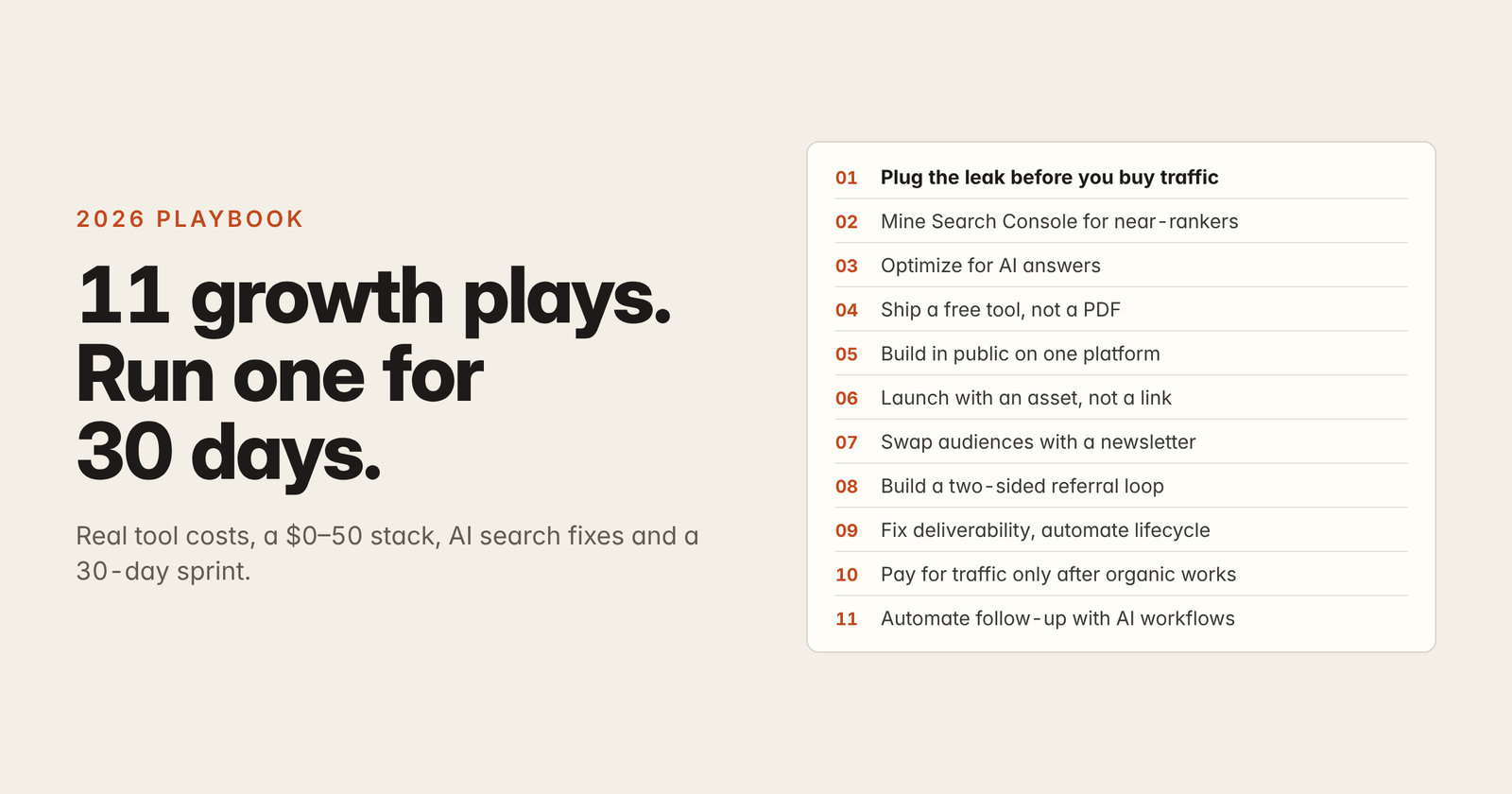
Here are 11 growth marketing tactics you can actually execute this month, with real tool prices, a 30-day sprint, and the traps that quietly eat your budget. 💸
This is for solo founders, creators, freelancers, and small teams. No mergers, no “synergy,” no $50k agency retainer. Just growth marketing tactics that move a number you can see in your dashboard.
⚡ Key Takeaways
- Retention first. Fixing onboarding and churn costs less than buying traffic, and it makes every other channel work harder.
- AI search is the 2026 gap. Google’s own guidance says llms.txt, forced chunking, and special schema aren’t required. Clear, crawlable answers are.
- A full stack can cost $0. Search Console, GA4, Clarity, PostHog, and Tally all have real free tiers.
- Free tools beat PDF lead magnets. They earn links, signups, and AI citations at the same time.
- Run one tactic for 30 days. Eleven half-run experiments produce exactly zero signal.
What Are Growth Marketing Tactics?
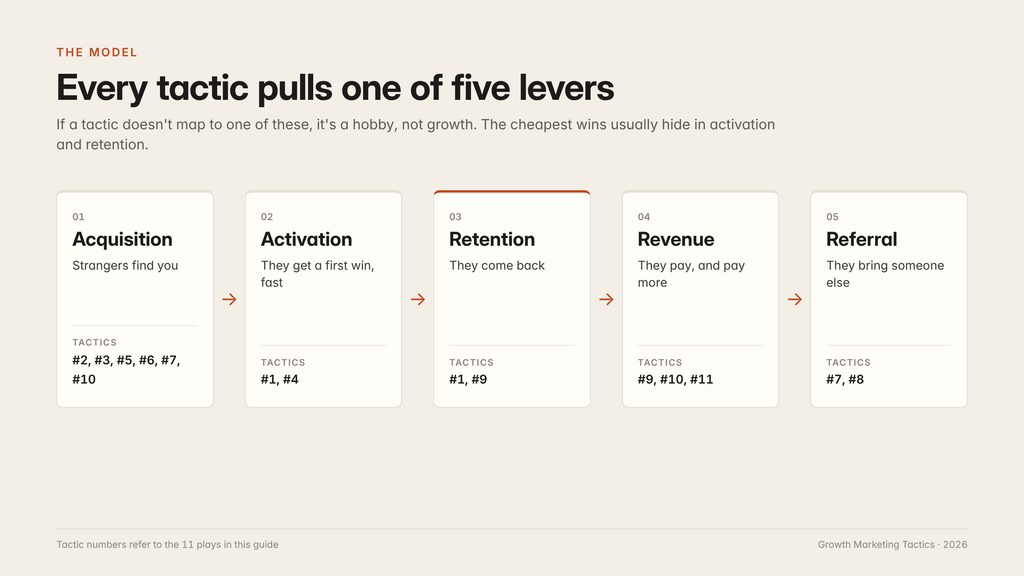
Growth marketing tactics are specific, testable actions that move a measurable number across the customer journey. Each one has a hypothesis, a metric, and a deadline — which is what separates it from “doing marketing.”
Definition: Growth marketing tactics are individual, measurable experiments that improve one stage of the funnel — acquisition, activation, retention, revenue, or referral. Unlike broad brand campaigns, each tactic targets a single metric, runs for a fixed window, and gets killed or scaled based on the result.
Say it plainly: a tactic is “add a 3-step onboarding checklist and measure day-7 activation.” A strategy is “become the default tool for freelance designers.” Tactics are the moves; strategy is the board. 🎯
Growth marketing vs growth hacking
Growth hacking usually means one-off, top-of-funnel tricks: a viral loop, a scraped integration, a launch-day spike. Growth marketing covers the whole funnel and keeps working after the spike fades.
Most growth hacking tactics you see online are acquisition-only, which is exactly why they plateau. The growth marketing tactics below cover all five stages, because the cheapest growth is almost always hiding in activation and retention.
The five levers every tactic pulls
- Acquisition: strangers find you.
- Activation: they get a first win, fast.
- Retention: they come back.
- Revenue: they pay, and pay more.
- Referral: they bring someone else.
If a tactic doesn’t map to one of these, it’s a hobby, not growth.
The $0–50/Month Growth Marketing Stack

You don’t need an enterprise suite to run these growth marketing tactics. The stack below covers measurement, behavior, email, and research for roughly the price of two lunches — and most of it is free forever.
| Tool | Job | Free tier | Paid entry |
|---|---|---|---|
| Google Search Console | Search + AI visibility | Free | — |
| Google Analytics 4 | Traffic and conversion events | Free | — |
| Microsoft Clarity | Heatmaps + session recordings | Free forever, no traffic limits | — |
| PostHog | Product analytics and funnels | 1M events/month | ~$0.00005/event after |
| Tally | Forms, waitlists, surveys | Unlimited forms + submissions | $24/mo billed yearly |
| Resend | Transactional + lifecycle email | 3,000/mo, 100/day | From $20/mo |
| Ahrefs Starter | Keyword and backlink research | — | $29/mo |
| n8n (self-hosted) | Automation workflows | Community edition free | Cloud plans vary |
Two honest caveats. Clarity keeps recordings for 30 days, so export anything you want to reference later. And Ahrefs Starter caps you at 50 tracked keywords, which is fine for a niche site and annoying for an agency.
Pro tip most stacks miss: define one north-star event in PostHog or GA4 before you launch anything. If you can’t answer “did activation go up?” in one click, you’re not running growth marketing tactics — you’re just posting. 📊
11 Growth Marketing Tactics That Work in 2026

Run these roughly in order. The first three cost almost nothing and fix your foundation; the rest compound on top. Every growth marketing tactic below is something you can start this week, not a quarter-long project.
1. Plug the leak before you buy traffic
Pull 20 session recordings of people who signed up and never came back. You’ll usually find the same three things: a confusing first screen, an empty state with no next step, and a paywall before any value.
- Add a 3-step checklist to your empty state.
- Cut signup fields to the bare minimum.
- Send one “here’s your first win” email 10 minutes after signup.
Cost: $0. Time to signal: 1–2 weeks. Least glamorous play on this list, highest return, fr.
2. Mine Search Console for pages that almost rank
Filter for queries where you sit at position 8–20 with real impressions. Those pages are one refresh away from page one, and demand is already validated.
- Rewrite the title and H1 to match the query exactly.
- Add a direct 40–60 word answer near the top.
- Add three internal links from your strongest pages.
- Update anything stale, then request indexing.
Cost: $0. Time to signal: 2–6 weeks. This is the cheapest SEO win available, and one of the few growth marketing tactics with no real downside.
3. Optimize for AI answers, and skip the llms.txt hype
Getting cited in ChatGPT, Perplexity, and AI Overviews is now a real acquisition channel. The good news: Google’s own AI optimization guide says you don’t need machine-readable files like llms.txt, you don’t need to chop content into tiny chunks, and there’s no special schema required for generative AI search.
Answer engine optimization (AEO) is the practice of structuring content so AI assistants and answer engines can extract, trust, and cite it. It prioritizes direct answers, clean heading hierarchy, crawlable HTML, and factual accuracy over keyword density or special markup.
What actually helps answer engine optimization:
- Answer the question in the first two sentences of each section.
- Use real headings, clean HTML, and let crawlers in.
- Make every section make sense if it gets quoted alone.
- Watch Search Console’s Generative AI performance report, which launched in June 2026 and shows impressions and pages — but no click data.
Cost: $0. Time to signal: 4–8 weeks. Anyone selling an “llms.txt ranking package” is selling vibes. 🤖
4. Ship a free tool instead of a PDF lead magnet
A calculator, grader, generator, or template gallery earns backlinks, signups, and AI citations simultaneously. A PDF earns one email address and then gets forgotten.
- Pick one repetitive question your audience keeps asking.
- Build the smallest useful version in a weekend.
- Gate the export, not the tool itself.
- Put it in your nav, not a buried landing page.
If building feels shaky, learning software engineering in the AI era covers the fundamentals that keep a vibe-coded tool from collapsing under real users.
Cost: $0–20/mo hosting. Time to signal: 1–3 months.
5. Build in public on one platform
Pick one platform where your buyers already are, then post the process instead of the press release. Screenshots of real numbers, mistakes, and decisions outperform polished announcements every time.
- Post 3–5 times a week for 90 days.
- Show the artifact: a dashboard, a workflow, a before-and-after.
- Turn your best post into short video — motion graphics with Claude gets you animated explainers without an editor or a subscription.
Cost: $0. Time to signal: 2–4 months. One platform done well beats five done badly. 🔥
6. Launch with an asset, not a link
A launch is a distribution event, and “we’re live!” converts nobody. Ship something people can use in the first 60 seconds: a free tier, a template, a demo that needs no signup.
- Prep 10–15 people who will genuinely engage on day one.
- Write the maker comment as a story, not a feature list.
- Have a real offer ready for the traffic spike.
Cost: $0. Time to signal: an immediate spike, then decay. Treat launches as a starting line, not a strategy.
7. Swap audiences with a complementary newsletter
Find five newsletters or creators who serve the same person but sell something different. A recommendation swap or a co-written issue puts you in front of warm readers for free.
- Pitch a specific idea, never “let’s collab.”
- Start with a one-time recommendation swap.
- Track it with a unique link or a signup question.
Cost: $0. Time to signal: 1–4 weeks. Ten small swaps beat one hopeful viral post.
8. Build a two-sided referral loop
Referrals only compound when both sides get something real. Give the referrer and the friend the same concrete reward — credits, a month free, a template pack — and show progress inside the product.
- Trigger the ask right after a user’s first win.
- Make the reward instant, not “after review.”
- Cap abuse with one reward per verified account.
Cost: the reward itself. Time to signal: 1–3 months. Track referral conversion, not referral count.
9. Fix deliverability, then automate the lifecycle
Email is the one channel you fully own, but only if it lands. Authenticate your sending domain with SPF, DKIM, and DMARC, make unsubscribe one click, and stop mailing people who haven’t opened in 90 days.
Then automate three flows: welcome, activation nudge, and win-back. Resend’s free tier covers 3,000 emails a month, which is plenty to start.
Cost: $0–20/mo. Time to signal: 2–4 weeks. A smaller clean list beats a big burnt one. 💸
10. Only pay for traffic after organic proves the offer
Paid ads amplify a message that already converts. If nobody signs up from organic, buying clicks just gets you rejected faster.
- Wait until one landing page beats your baseline conversion rate.
- Start at $10–20/day on one channel and one audience.
- Kill anything without signal after 100 clicks.
Cost: $300–600/mo to learn anything useful. Time to signal: 2–4 weeks. This is where budgets go to die, so go last.
11. Automate the follow-up with AI workflows
The gap between “someone showed interest” and “a human replied” is where small businesses leak revenue. Automate that gap: lead routing, instant follow-up, meeting booking, review requests, churn-risk alerts.
- Map one workflow end to end before you touch a tool.
- Build it in n8n, Make, or Zapier.
- Add a human approval step for anything that moves money or messages customers.
Going the agent route? ChatGPT Dots breaks down OpenAI’s always-on agents, what they cost, and where the safety limits sit.
Cost: $0–30/mo. Time to signal: 1–2 weeks. Test 20 real scenarios before you trust it. 🚀
Which Growth Marketing Tactics Should You Pick?

Pick based on your bottleneck, not on what’s trending. Most people should run two growth marketing tactics at a time: one foundation play and one distribution play.
- Traffic but no signups: start with #1 and #4. Your offer or first-run experience is the problem.
- Signups but no revenue: run #9 and #8. Activation and referral are leaking.
- No traffic at all: run #2, #3, and #5. Search plus one social platform is your base.
- Revenue but flat: run #7, then #10.
- Freelancer or agency: #4 and #5 build inbound leads while you sleep.
- Budget under $50/month: everything except #10.
The worst move is running all eleven growth marketing tactics at once. You’ll get noise, burn out, and conclude that growth doesn’t work. It’s giving scattered. 😬
Your 30-Day Growth Sprint

Here’s the sequence that turns a list of growth marketing tactics into a habit instead of a bookmark.
Week 1 — Measure. Install Search Console, GA4, Clarity, and PostHog. Define one north-star metric. Record your baseline. Watch 20 sessions of drop-off.
Week 2 — Fix. Ship tactic #1. Refresh your three weakest high-impression pages (#2). Add direct answers to your top five posts (#3).
Week 3 — Distribute. Start posting on one platform (#5). Pitch five newsletter swaps (#7). Ship or scope your free tool (#4).
Week 4 — Compound. Turn on the three email flows (#9). Add the referral ask (#8). Review the numbers, kill what didn’t move, and pick next month’s two tactics.
Thirty days of focused growth marketing tactics won’t make you rich. It will give you a baseline, one working channel, and the data to choose correctly next time. That’s the whole game. 🔁
Mistakes and Red Flags That Kill Growth
Most growth marketing tactics fail for boring reasons: no baseline, no deadline, and too many running at once. Watch for these.
- No control. Change five things at once and you’ve learned nothing.
- Vanity metrics. Impressions and followers aren’t revenue. Track activation and paid conversion.
- Fake “AI SEO” packages. llms.txt files, guaranteed AI citations, and “secret schema” aren’t things Google asks for.
- Mass-produced AI content. YouTube’s monetization rules now target inauthentic, mass-produced content, and Google’s spam policies treat scaled content abuse as a violation. Low effort = L.
- Buying email lists. Deliverability dies, and it dies permanently.
- Hiring before you know what works. No agency can fix an offer nobody wants. If you do hire, know that tech hiring has changed — specialists with proof beat generalists with certificates.
- Guaranteed anything. Guaranteed rankings, guaranteed virality, guaranteed ROI. No cap, that’s a scam. 🚩
FAQ
What are the main growth marketing tactics?
The core growth marketing tactics are retention and onboarding fixes, SEO refreshes of near-ranking pages, AI answer optimization, free tools as lead magnets, building in public, launches, newsletter swaps, referral loops, lifecycle email, paid ads, and automation. Start with retention and search, because they cost nothing and improve every other channel.
What’s the difference between growth marketing and growth hacking?
Growth hacking focuses on quick, top-of-funnel wins like viral loops and launch spikes. Growth marketing covers the full funnel — acquisition, activation, retention, revenue, and referral — and keeps working after the spike fades. Hacking is a subset, not a replacement.
How do I grow my business with no marketing budget?
Use free tools and free channels. Search Console, GA4, Microsoft Clarity, PostHog, and Tally all have genuine free tiers. Then run near-ranking page refreshes, one social platform, newsletter swaps, and a free tool. These growth marketing tactics cost nothing but hours.
Does llms.txt help you rank in AI search?
No. Google’s AI optimization guide states that Google Search doesn’t use machine-readable files like llms.txt, and that there’s no requirement to chunk content into tiny pieces or add special schema. Some AI labs publish llms.txt for their own documentation, but it isn’t a ranking lever.
How do I measure whether a growth tactic worked?
Set one metric and one baseline before you start, then give it a fixed window of two to six weeks. Change one thing at a time. If the metric doesn’t move, kill it and move on instead of stacking more tactics on top.
Pick One Tactic and Run It for 30 Days

None of these growth marketing tactics are secret. The edge is sequencing: fix the leak, get found in search and AI answers, then distribute through one channel you can actually sustain.
Your next step is small. Open Search Console, find the page sitting at position 11, and rewrite it today. Then pick one more from this list of growth marketing tactics and give it 30 days. Momentum beats motivation, and W’s are built, not found. 🚀


Leave a comment