
Yes, learning software engineering in the AI era is still worth it, but the version that pays off in 2026 is not “memorize syntax and grind tutorials.” AI can spit out a working app in seconds; what employers now pay for is the person who can tell when that app is quietly broken. 🤖
This guide to learning software engineering in the AI era gives you the real job data, study habits backed by actual experiments, the free tools worth using, and a step-by-step roadmap. No hype, no “become a 10x dev in 30 days” nonsense.
Is Learning Software Engineering in the AI Era Still Worth It?
Yes, if you go in with clear eyes. Demand for people who can build and maintain software is still rising overall; what has shrunk is the number of “easy” junior seats where companies used to train beginners on simple tickets.
Start with the long-run numbers. The US Bureau of Labor Statistics projects employment of software developers, QA analysts and testers to grow 10% from 2025 to 2035, versus 3% for all occupations, with about 106,100 openings per year. The median annual wage for software developers was $135,980 in May 2025.
Now the part most “learn to code” articles skip. BLS projects computer programmer jobs to fall 7% over the same decade, partly because companies use AI to automate repetitive programming tasks. Pure code-typing is shrinking, while the broader engineering role (design, testing, shipping, owning systems) keeps growing.
The World Economic Forum’s Future of Jobs Report 2025 points the same way, listing software and applications developers among the fastest-growing jobs and “AI and big data” as the fastest-growing skill. So learning software engineering in the AI era is less about “will there be jobs” and more about “which version of the job will you be ready for.”
What AI Has Actually Changed for Beginners
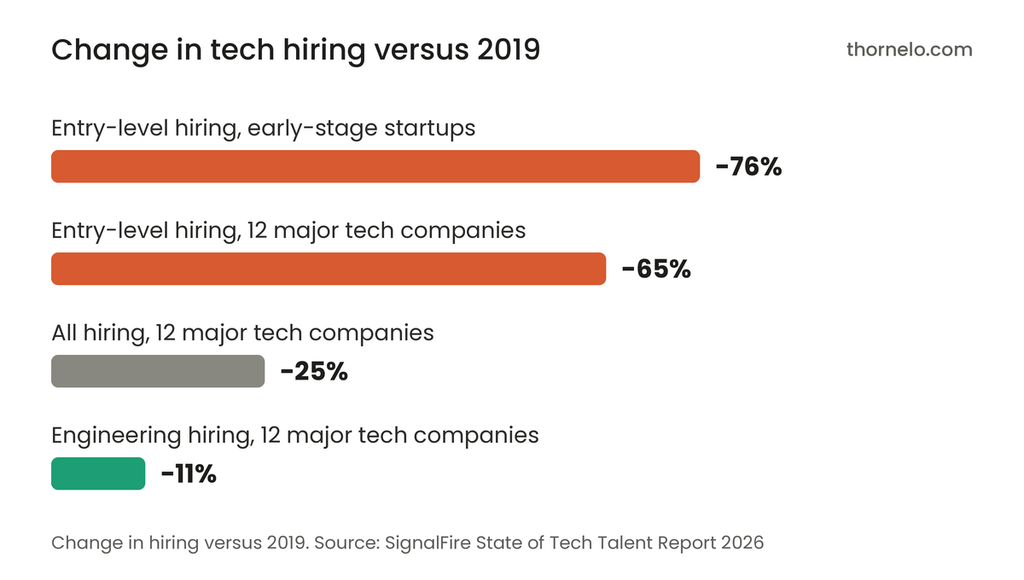
For anyone learning software engineering in the AI era, the biggest change is this: AI hasn’t killed the junior developer, but it has raised the bar for what a junior is expected to do on day one. Entry-level hiring has dropped hard, while hiring for engineers overall has held up surprisingly well.
Definition: AI-era software engineering. Software engineering in the AI era means designing, building, testing and maintaining software while AI coding assistants and agents handle much of the routine code generation. The human’s job shifts toward defining problems, reviewing and debugging AI output, making architecture trade-offs, and taking responsibility for what ships to production.
The hiring data is sobering. SignalFire’s 2026 State of Tech Talent Report found new grad and entry-level hiring down roughly 65% at 12 major tech companies and about 76% at early-stage startups compared with 2019. Yet engineering hiring at those big companies fell only 11% while overall hiring fell 25%, and engineers now make up 55% of all hires, up from 46% in 2019.
Stanford’s Digital Economy Lab adds a second data point. Its August 2026 revision of the Canaries in the Coal Mine study, based on payroll data through June 2026, found no evidence of widespread job displacement, but employment of workers aged 22–25 in AI-exposed occupations now sits 19% below where it would be had it kept pace with less-exposed peers, while experienced workers show no comparable gap.
Read together, the data says one thing: companies still want engineers, they just want them to arrive more useful. Our breakdown of how tech hiring works right now goes deeper on what recruiters screen for.
One more twist worth knowing. Top CS graduates in 2025 were twice as likely to call themselves founders as the 2022 class, and Stack Overflow’s 2026 Developer Survey saw respondents working in an “organization of one” jump from 4% to 10%. Building your own thing is lowkey becoming a real entry path.
How AI Helps (and Hurts) When You’re Learning to Code
If you’re learning software engineering in the AI era, AI speeds you up on things you already understand, but it can quietly block you from learning things you don’t. The difference comes down to one choice: asking AI to explain, or asking it to do.
The strongest evidence comes from a randomized controlled trial Anthropic published in January 2026. Researchers had 52 mostly junior developers learn an unfamiliar Python library called Trio, some with an AI assistant and some without. The AI group averaged 50% on a follow-up quiz versus 67% for the hand-coding group, with the biggest gap on debugging questions. The AI group finished only about two minutes faster, a difference that wasn’t statistically significant.
Here’s the hopeful part. Not every AI user scored badly. Participants who used AI mainly for conceptual questions, or who asked for explanations alongside generated code, averaged 65% or higher. Those who handed all the coding to AI averaged below 40%.
Definition: cognitive offloading. Cognitive offloading is handing mental work to a tool so your brain doesn’t have to do it. In coding, it looks like pasting an error into an AI and accepting the fix without understanding the cause. It feels productive, but research suggests it can weaken the debugging and code-reading skills you need to supervise AI later.
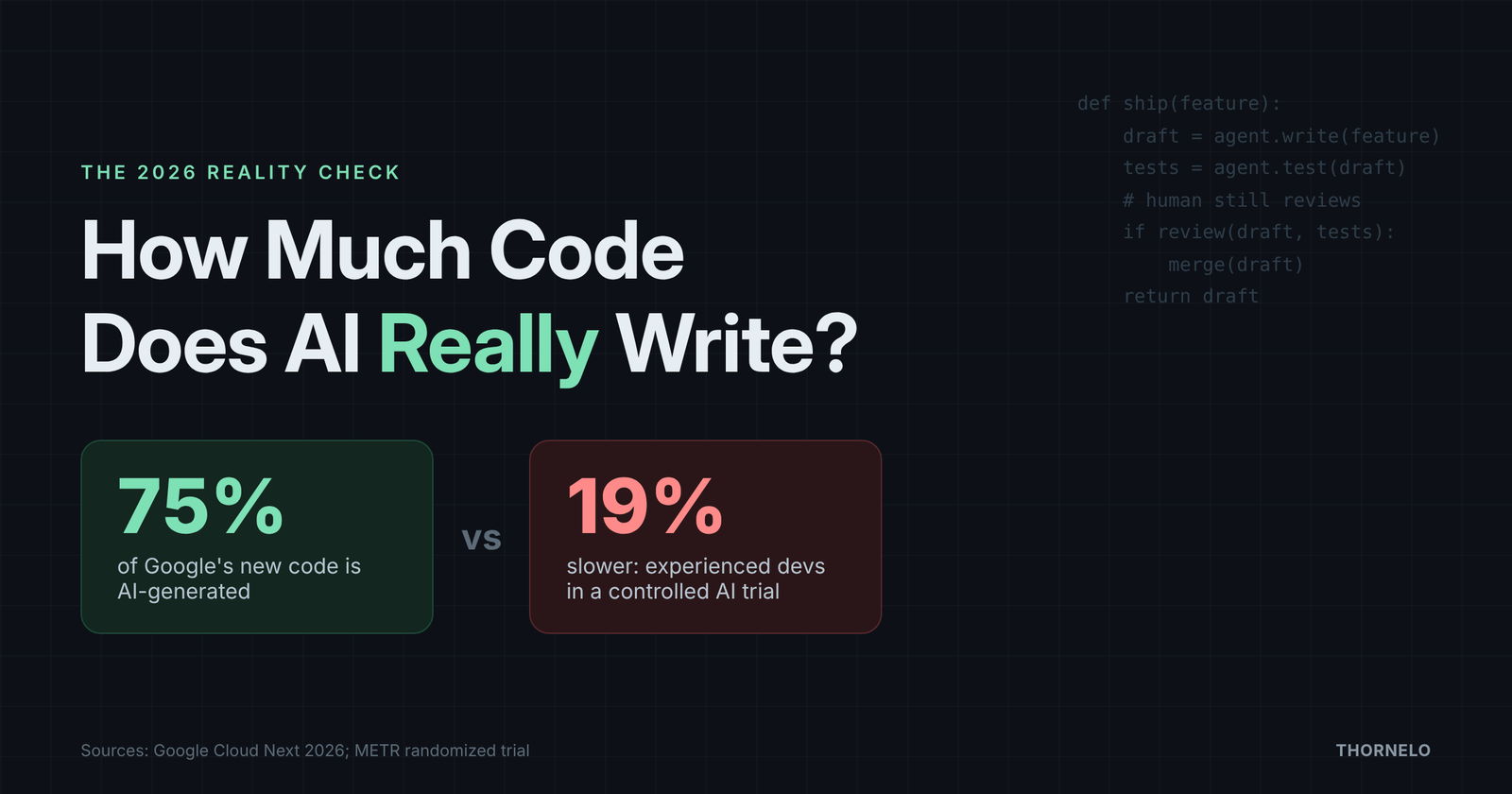
Experienced developers aren’t immune to the illusion either. In METR’s 2025 trial, 16 experienced open-source developers took 19% longer on real tasks when AI was allowed, yet believed AI had sped them up. A February 2026 follow-up suggested newer tools likely do speed developers up, though the exact gain is unclear. Lesson: your feeling of productivity is not a measurement.
Professional developers have noticed. In Stack Overflow’s 2025 survey, 84% of respondents used or planned to use AI tools, but only 29% trusted their accuracy, and 66% named “AI solutions that are almost right, but not quite” as their biggest frustration. That gap between “looks right” and “is right” is exactly where your value as an engineer lives, no cap.
Learning Software Engineering in the AI Era: The 7-Step Roadmap
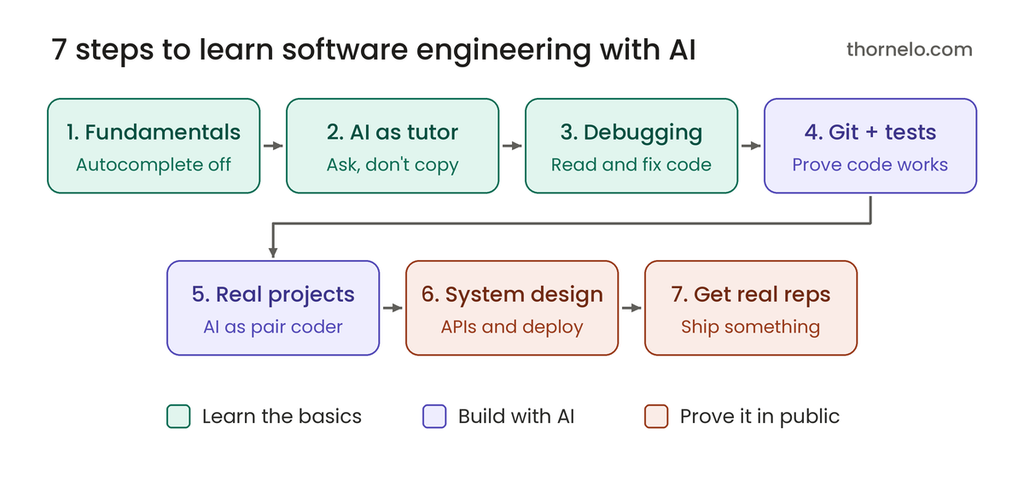
This roadmap for learning software engineering in the AI era front-loads fundamentals, then adds AI as your skills grow. Treat 9–15 months of consistent part-time study (10–15 hours a week) as a rough planning range, not a promise.
Step 1: Learn the fundamentals with autocomplete off (months 1–3)
Pick one language (Python or JavaScript/TypeScript are safe defaults) and learn variables, loops, functions, data structures and basic algorithms. Turn off inline AI autocomplete for this phase. You can ask a chatbot to explain a concept, but type every line yourself.
Struggling through errors is the workout; skipping it is skipping leg day. TypeScript became the most-used language on GitHub in August 2025, overtaking Python and JavaScript, so either path keeps doors open.
Step 2: Use AI as a Socratic tutor, not an answer machine
Switch on tools built for learning. ChatGPT’s Study Mode (launched July 2025) guides you with questions instead of handing over answers, and Claude Code’s Learning output style explains its choices and leaves small pieces of code for you to write yourself.
Harvard’s CS50 takes the same approach: its course policy allows its own AI “duck” tutor but rules out tools that complete answers or code for you.
Step 3: Make debugging and code reading your specialty
Since the Anthropic trial found debugging was the skill most hurt by heavy AI reliance, make it your strength. Read other people’s code on GitHub, step through programs with a debugger, and keep a bug journal where you write each bug, its root cause and the fix in your own words.
Step 4: Learn Git, testing and the command line
Version control, unit tests and terminal basics are non-negotiable in 2026. Tests matter even more now because they’re how you prove AI-generated code actually works. Write the test first, let AI attempt the implementation, then check it against your test.
Step 5: Build real projects with AI as a pair programmer
Now bring in full AI help. Build 2–3 projects that solve real problems, like a budgeting tool, an API for a local business, or a browser extension. Use coding agents for boilerplate, but write the core logic yourself and be able to explain every file.
Our guide to building a developer portfolio with no experience shows how to package these projects for recruiters.
Step 6: Learn system design and how AI systems work
Learn how databases, APIs, caching and deployment fit together, then learn the basics of large language models (LLMs), retrieval-augmented generation (RAG) and calling AI APIs. Knowing how to build with AI, not just prompt it, sets you apart.
Step 7: Get real-world reps before your first job
Contribute to open source, take small freelance gigs, or ship your own micro-product. Even small paid work proves you can handle messy requirements. Our guides to setting up a Fiverr profile as a CS student and earning $500 a month as a student walk through the first steps. 💸
As illustrative math only: 3 small clients × $300/month for website maintenance = $900/month. That’s not a claim about what you’ll earn; it just shows how small, repeatable gigs can add up while you learn.
The Best AI Tools for Learning Software Engineering in the AI Era
You can start learning software engineering in the AI era for close to $0. Most useful tools have free tiers, and students get extra perks, so the trick is using each one at the right stage.
| Tool | Cost (Oct 2026) | Best stage | How to use it for learning |
|---|---|---|---|
| ChatGPT Study Mode | Available on the Free plan | Steps 1–3 | Ask for hints and quizzes, not full solutions |
| Claude Code (Learning style) | Requires a Claude plan; check current pricing | Steps 2–5 | Let it leave small code pieces for you to write |
| GitHub Copilot Free | $0 (2,000 completions/month) | Steps 5–7 | Turn on autocomplete only after fundamentals click |
| GitHub Copilot Student | $0 for verified students | Steps 5–7 | Full assistant for projects, not for exercises |
| Harvard CS50 + CS50 Duck | Free to take online | Steps 1–3 | Structured course with a guardrailed AI tutor |
Verified students can claim the free Copilot Student plan through GitHub Education, everyone else gets Copilot Free, and Copilot Pro costs $10 a month; details sit on the official GitHub Copilot plans page. Free and Student plans now pick the AI model automatically, so don’t expect to choose specific models.
These tools are also job prep. Among developers who use AI coding agents, Stack Overflow’s 2026 survey found Claude Code (66%) and GitHub Copilot (59%) were the most used.
Which Learning Path Should You Pick?
Choose your route for learning software engineering in the AI era based on money, time and how much structure you need. All three paths can work when paired with real projects.
- CS degree (3–4 years): Best if you want deep theory, internships, formal credentials, or roles in AI/ML research. Highest cost and time.
- Bootcamp (3–9 months): Best if you need structure and a cohort fast. Quality varies a lot, so check recent, verifiable outcomes before paying.
- Self-taught with AI tutors (9–18 months part-time): Best if you’re disciplined and budget-limited. The hardest parts are staying accountable and proving skills without a credential.
My decision rule: if you can access an affordable degree, a degree plus internships is still the safest bet in a market that favors experience. If you’re switching careers, self-teaching plus freelance work and a strong portfolio is usually the faster route to proof.
Common Mistakes to Avoid

The biggest mistake people make when learning software engineering in the AI era is confusing “I made it work” with “I understand it.” Here are the traps that show up most:
- Vibe coding through tutorials. If you can’t rebuild it without AI, you didn’t learn it.
- Skipping fundamentals because “AI handles syntax.” You still need them to spot bad AI output.
- Only building tutorial clones. Recruiters have seen a thousand to-do apps.
- Ignoring testing and Git. These are the first things a team expects.
- Trusting AI blindly. In Stack Overflow’s 2025 survey, more developers distrusted AI accuracy (46%) than trusted it (33%).
Reality Check: Red Flags and Hype to Ignore
Learning software engineering in the AI era attracts plenty of hype, so filter claims hard. Anyone promising a guaranteed six-figure job in 90 days, or claiming you “don’t need to learn to code anymore,” is selling something.
Watch for bootcamps that won’t share audited placement data, “prompt engineering certificates” with no projects attached, and courses that teach you to generate apps without ever reading the code. Be skeptical of viral productivity stats too, since even experienced developers misjudged their own speed with AI, fr.
For a calmer read on where AI is heading overall, see our take on what AI will actually do to humanity by 2029.
The “Two-Repo Rule”
Here’s a habit for learning software engineering in the AI era that most guides never mention: keep two separate workspaces. In your learning repo, AI autocomplete stays off and you only ask conceptual questions. In your project repo, you use AI agents freely to ship faster.
Once a week, pick one AI-written function from your project repo, delete it, and rewrite it from memory in your learning repo. If you can’t, that’s your study topic for the week. This mirrors the “generate code, then ask follow-up questions until you understand it” pattern that scored well in the Anthropic trial. 🔥
Frequently Asked Questions
Will AI replace software engineers?
Current evidence says AI is reshaping the job rather than erasing it. BLS still projects 10% growth for software developers, QA analysts and testers from 2025 to 2035, while pure computer programmer roles are projected to shrink 7%. The engineers most at risk are those who only write routine code without design, testing or ownership skills.
Is it still worth learning to code in 2026?
Yes, if you learn to engineer, not just to type code. Learning software engineering in the AI era means pairing fundamentals with AI fluency, since 73% of developers who use AI coding tools in Stack Overflow’s 2026 survey use them daily. Coding knowledge is what lets you judge AI output.
How long does it take to learn software engineering with AI tools?
For learning software engineering in the AI era, treat 9–15 months of consistent part-time study (10–15 hours a week) as a rough planning range for an entry-level portfolio. AI can speed up project building, but research suggests it doesn’t shortcut the time needed to truly understand new concepts.
Should beginners use AI tools like ChatGPT or Copilot?
Yes, but carefully: learning software engineering in the AI era works best when you start with learning modes like ChatGPT Study Mode or Claude Code’s Learning style and keep autocomplete off until fundamentals click. In the 2026 Anthropic trial, learners who asked conceptual questions kept high scores, while those who delegated everything scored lowest.
Are junior developer jobs disappearing because of AI?
They’re shrinking, not disappearing. SignalFire’s 2026 report found entry-level hiring down about 65% versus 2019 at major tech companies, while engineering hiring overall fell only 11%. Juniors now need stronger portfolios, real project experience and AI skills to compete.
What skills matter most for software engineers in the AI era?
Debugging, code reading, testing, system design and communication top the list, followed by knowing how to build with AI APIs and agents. These are the skills AI can’t reliably own, and they’re what employers need to supervise AI-generated code safely.
Do I need a computer science degree in 2026?
No, but a degree helps more in a market that favors experienced candidates. It brings internships and credentials, while self-taught learners need a strong portfolio, open-source contributions or paid freelance work to prove their skills.
Final Thoughts
Learning software engineering in the AI era rewards people who build understanding, not just output. The jobs data shows the field is growing but the junior door is tighter, and the learning research shows AI can sharpen or dull your skills depending on how you use it.
Your one next step: this week, set up a learning repo with autocomplete off, turn on a learning mode (ChatGPT Study Mode or Claude Code’s Learning style), and solve five small problems where you write every line yourself. That’s how you start learning software engineering in the AI era the right way. 🚀
Leave a comment