
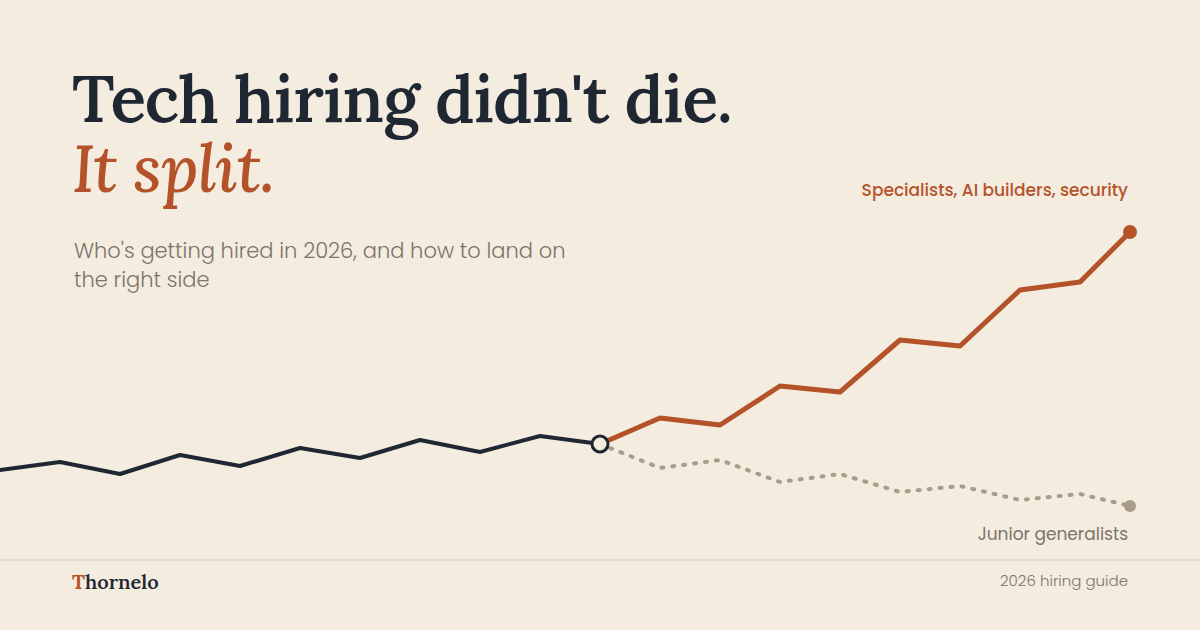
Tech hiring has changed, and not in the “everything is dead” way your feed keeps screaming about.
Postings are recovering, but the recovery is going mostly to experienced specialists, AI-fluent builders, and security people, while junior generalists are stuck outside the door.
This guide breaks down what the latest 2026 data actually shows, who is getting hired, how interviews work now, and a step-by-step plan to get on the right side of the split. No hype, no doom, just the receipts. 🔥
Key Takeaways
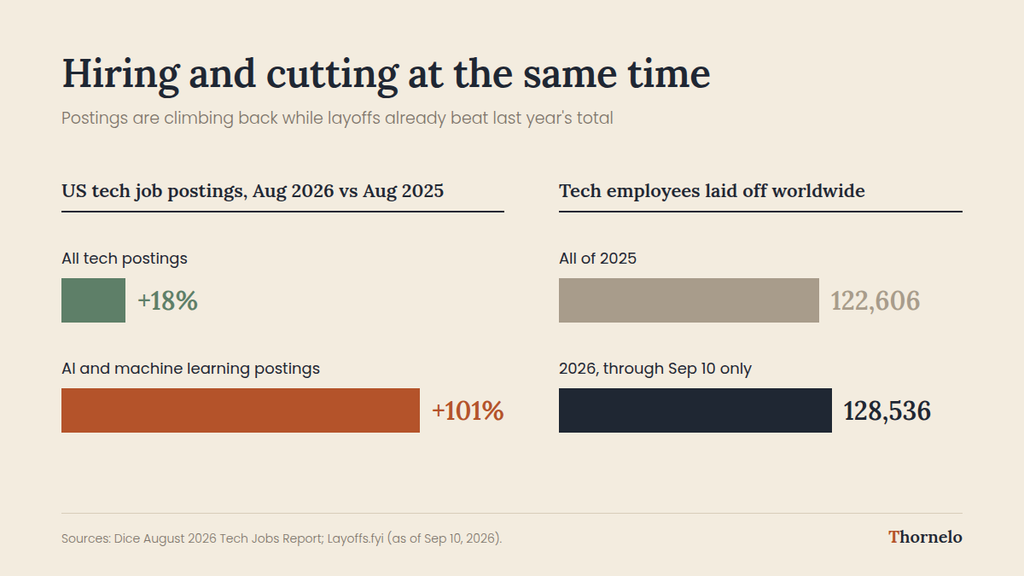
- Tech hiring in 2026 is recovering, not collapsing: Dice counted US tech postings up 18% year over year in August 2026, and AI/ML postings up 101%. dice
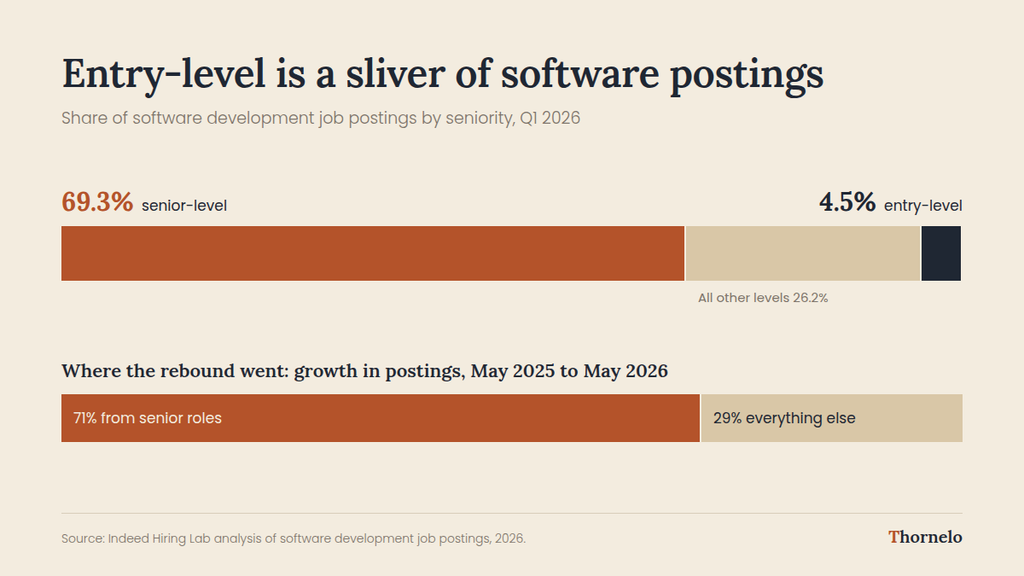
- The recovery is senior-heavy. Indeed found 71% of the rebound in software development postings came from senior roles. Indeed Hiring Lab
- Employers want depth over breadth. Revelio Labs found the average tech posting dropped about 25%, from 30 listed skills to 21, while required experience edged up about 4%.
- Entry-level tech jobs are the weak spot. Stanford researchers estimate employment for 22-to-25-year-olds in AI-exposed jobs sits 19% below trend. Stanford
- In-person interviews are back because of AI cheating and fake candidates. Computerworld
- Your best move: pick one specialization, ship proof of work, and be able to explain every line without AI.
What Does “Tech Hiring Has Changed” Actually Mean?
It means the market split in two. Demand for experienced, specialized, AI-capable people is growing again, while demand for junior generalists who mainly write routine code is still weak.
Definition: The 2026 tech hiring split. Tech hiring in 2026 describes a market where total postings are rising again but gains are concentrated in senior, specialized, and AI-related roles. Employers list fewer skills per job, ask for more years of experience, verify candidates more strictly, and increasingly test how well people work with AI tools rather than without them.
Here’s the thing most headlines miss: both stories are true at the same time. The Indeed Hiring Lab September 2026 snapshot showed overall US job postings up 0.7% year over year, the first positive annual reading in nearly four years.
Indeed Hiring Lab But software development postings were still 27.5% below their February 2020 level as of mid-2026, even after a year-long rebound. Indeed Hiring LabFRED
So if you’re a staff engineer with AI infrastructure experience, the market lowkey feels fine. If you’re a 2026 grad with a generic web app portfolio, it feels brutal. Same market, different doors.
Is Tech Hiring Recovering in 2026?
Yes, but unevenly. Posting volume is up meaningfully from 2025 while layoffs remain high, which is why the market feels contradictory depending on where you stand.
On the demand side, Dice’s August 2026 jobs report found tech job postings up 18% versus August 2025, even after a 2% monthly dip.
AI and machine learning postings grew 101% over the same period, more than five times the overall rate.
Manufacturing, software, consulting, technology, and retail all grew tech postings by more than 30% year over year, so the demand isn’t only coming from tech companies. dice
CompTIA’s monthly Tech Jobs Report tells a similar story. In its June 2026 analysis, the tech occupation unemployment rate fell to 2.9%, compared with a 4.2% national rate, and new tech job postings rose for the sixth month in a row.
PR Newswire CompTIA’s forecast for the year is net tech employment growth of 1.9%, or roughly 185,500 jobs. CompTIA
Now the other side. Layoffs.fyi counted 128,536 tech employees laid off at 299 companies worldwide by September 10, 2026, already above the 2025 full-year total of 122,606.
tradingview Challenger, Gray & Christmas counted 155,126 announced US tech job cuts through August, up 52% from the same point in 2025. challengergray The pattern is fewer companies cutting deeper, often while spending heavily on AI.
That combo explains the vibe. Companies are cutting in one place and hiring in another, and the people being hired rarely look like the people being let go. 🤖
Which Tech Roles Are in Demand Right Now?
The strongest demand is for AI and machine learning engineers, AI product managers, data and AI infrastructure people, cybersecurity specialists, and architects who connect AI to existing systems. Broad “full-stack generalist” demand is weaker.
Tech hiring right now favors people who own a specific, high-stakes problem. Dice flagged AI product managers, application systems analysts, and lead solution architects among the fastest-growing job titles in August 2026, alongside SAP modernization roles.
Skills growing more than 200% year over year included Responsible AI, AI agents, agentic AI, and AI infrastructure, which tracks with the shift from simple chatbots toward autonomous agents that need governance, integration, and monitoring.
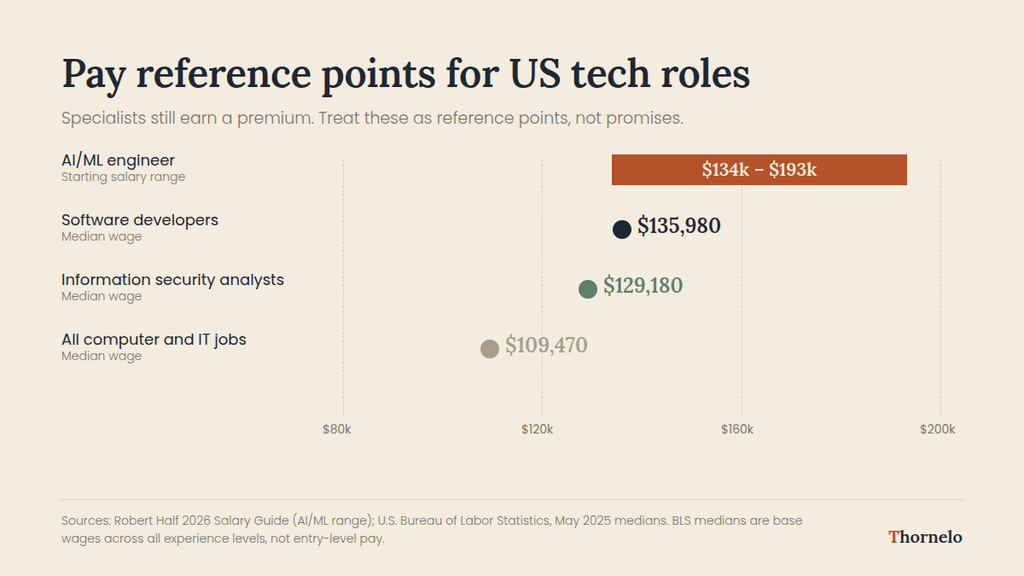
Security remains a steady bet. The US Bureau of Labor Statistics projects information security analyst jobs to grow 21% from 2025 to 2035, with a median wage of $129,180 in May 2025.
U.S. Bureau of Labor Statistics Software developers are projected to grow 10% over the same decade, while computer programmers, the role most tied to routine coding, are projected to decline 7%. U.S. Bureau of Labor StatisticsU.S. Bureau of Labor Statistics
That last contrast is the whole story in miniature. Writing code to spec is getting cheaper. Designing, securing, and owning systems is not.
Definition: Skill depth vs. skill breadth. Skill breadth is how many distinct tools and skills you can list. Skill depth is how many years of real, applied experience you have with a specific skill. In 2026, tech job postings ask for fewer skills overall but more experience in each, which signals that employers want proven specialists over generalists with long tool lists.
Revelio Labs’ Dean Boerner measured this across 75 million tech postings since 2024 in a September 1, 2026 analysis: the average skill count fell about 25%, from 30 to 21, while required years of experience edged up about 4%, from roughly 4.6 to 4.8 years.
Postings that mention AI in the responsibilities section list even fewer skills and want more experience. Translation: stop padding your resume with 40 logos.
Why Are Entry-Level Tech Jobs So Hard to Get?
Because the tasks junior people used to learn on, such as boilerplate code, simple tickets, and basic testing, are exactly the tasks AI coding tools now speed up.
Employers are hiring fewer juniors and more seniors who can supervise AI output.
Tech hiring for juniors has taken the hardest hit, and the data is hard to argue with. Indeed found that in Q1 2026, only 4.5% of software development postings were entry-level, while 69.3% were senior-level.
Indeed Hiring Lab Between May 2025 and May 2026, 71% of the increase in software development postings came from senior roles, and 37% came from jobs with “AI” in the title.
Stanford’s Digital Economy Lab, using ADP payroll data, found in its August 2026 update that employment of 22-to-25-year-olds in the most AI-exposed occupations sits about 19% below where it would be if it had kept pace with less-exposed peers.
Experienced workers show no comparable gap. The researchers call these early indicators rather than proof that AI caused the drop, and their own research update sums it up as no widespread displacement, but a widening gap for young workers.
New grads feel it. New York Fed data on 2024 outcomes put recent computer engineering graduates at 7.8% unemployment and computer science graduates at 7.0%, among the highest of any major.
The upside: those same majors still had the highest early-career median pay, at $90,000 and $87,000. Research.com The door is harder to open, not closed. 💸
How Has AI Changed the Tech Interview Process?
AI now sits on both sides of the table. Employers use AI to screen resumes and sometimes run interviews, candidates use AI to apply, and some use it to cheat, so companies are adding in-person rounds and redesigning technical tests.
Tech hiring teams are dealing with a trust problem. Gartner predicts that by 2028, one in four candidate profiles worldwide will be fake, and in its Q2 2025 survey of 3,000 job candidates, 6% admitted to interview fraud, either posing as someone else or having someone pose as them.
In a July 2025 Gartner survey, just 26% of job applicants said they trust AI to evaluate them fairly.
The response is a return to the room. Google, Cisco, and McKinsey have reinstated in-person interview rounds for some candidates, and a Gartner survey cited by Computerworld found 72.4% of recruiting leaders are running interviews in person to fight fraud,
though Gartner HR tech analyst Emi Chiba noted that in-person rounds alone aren’t enough and companies need “tests, ID checks, and smart screening” at every step.
Google CEO Sundar Pichai said the company would introduce “at least one round of in-person interviews” to make sure “the fundamentals are there.”
Other companies went the opposite way. Canva replaced a computer-science fundamentals round with an AI-assisted coding interview in 2025, and Coinbase has added an “AI fluency” signal to its engineering interviews.
Hedy AIEason Tech Talk So you’ll likely face both styles: one round where AI is banned, and another where using it well is the point.
Definition: AI fluency in hiring. AI fluency means using AI tools to produce reliable work, not just fast work. In a 2026 interview, it looks like prompting clearly, spotting wrong or insecure output, testing what the AI generated, and explaining the trade-offs. Employers increasingly treat it as a baseline skill for most tech roles, not a bonus.
Does Skills-Based Hiring Mean You Don’t Need a Degree?

Partly. More employers say they hire on skills, but many still quietly favor degrees in practice, so proof of work matters more than ever while a degree still helps at many companies.
NACE’s Job Outlook 2026 survey found 70% of employers use skills-based hiring, up from 65% a year earlier.
But a February 2024 Burning Glass Institute and Harvard Business School study found only the 37% of firms it classed as “Skills-Based Hiring Leaders” followed through, averaging 18% more non-degree hires, and that overall the shift showed up in “not even 1 in 700 hires.”
Many changed the job ad, not the decision.
The practical read: no degree is not a dealbreaker in 2026 tech hiring, but “skills-based” usually means “prove it faster.” Expect take-home tasks, work samples, and live problem-solving before a human reads your story.
How to Build a Developer Portfolio With No Experience
Is Remote Tech Work Still a Thing?
Yes, but fully remote roles are rarer and far more competitive than in 2021–2022. Hybrid is the default for most tech teams that allow flexibility.
Remote tech hiring has shrunk alongside the wider market. Robert Half’s Q2 2026 posting analysis across the professional fields it covers found 87% of postings fully on-site, 10% hybrid, and just 3% fully remote, with technology among the fields offering the most flexibility.
Robert HalfWorldatnet Remote roles also skew experienced, since companies are more willing to trust a proven senior person off-site.
The global angle matters too. Indeed’s data shows the software development share of postings rising in most large developed economies except Germany and France, Indeed Hiring Lab and Zinnov counts over 1,760 global capability centers in India, the in-house tech hubs multinationals run abroad, employing over 1.9 million professionals in 2025.
For many companies, “remote” now means “hire a team in another country,” not “let one person work from anywhere.”
What Do Tech Jobs Pay in 2026?
Pay is still strong for specialists and flat-ish for everyone else. AI and security roles command the biggest premiums, while general tech salaries have barely kept pace with inflation.
In tech hiring, pay data now splits the same way demand does. BLS puts the median software developer wage at $135,980 in May 2025, and the median for all computer and IT occupations at $109,470.
U.S. Bureau of Labor StatisticsU.S. Bureau of Labor Statistics Robert Half’s 2026 Salary Guide lists a US starting salary range of $134,000 to $193,250 for AI/ML engineers.
MangoThrive Dice’s 2025 Tech Salary Report found professionals designing, developing, or implementing AI solutions earned 17.7% more than peers not involved in AI work, though Dice notes those workers are also more likely to hold senior positions.
Keep two caveats in mind. BLS medians are base wages across all employers and are not entry-level pay, and big-tech total compensation with equity can be far higher or lower depending on the company. Articuler Use these as reference points, not promises.
Which Path Should You Pick?
Pick the path that matches the experience you already have, not the one with the hottest headline. The table below compares the main routes in 2026 tech hiring.
| Path | 2026 demand signal | US pay reference | Best for |
|---|---|---|---|
| AI/ML engineering | AI/ML postings +101% YoY (Dice) | $134k–$193k starting range (Robert Half) | Developers with strong math, data, or backend depth |
| AI product and solutions roles | AI product manager among fastest-growing titles | Varies widely by company | PMs, analysts, and consultants who know one industry well |
| Cybersecurity | BLS projects +21% growth to 2035 | $129,180 median (BLS) | IT support, networking, and sysadmin folks moving up |
| Data and AI infrastructure | AI infrastructure skills growing 200%+ YoY | $135,980 median for software devs (BLS) | Backend and cloud engineers |
| Freelance and contract | Upwork AI skills demand +109% YoY | Project-based; see illustrative math below | Experienced people and career switchers building proof |
If you’re early career, security and data infrastructure tend to offer clearer entry ramps than pure AI research, which leans heavily toward advanced degrees and senior experience. If you’re mid-career in a non-tech field, AI product and solutions roles reward domain knowledge that a new grad can’t fake, fr.
Is Freelancing a Real Alternative to a Full-Time Tech Job?
It can be, especially for experienced people, because companies increasingly buy specialized skills by the project instead of adding headcount. It’s a weaker option for complete beginners with no track record.
Upwork’s In-Demand Skills 2026 report found demand for top AI-related skills grew 109% year over year, led by AI video generation (+329%), AI integration (+178%), and data annotation (+154%).
Yahoo FinanceUpwork Its Future Workforce Index 2026 found freelancers doing AI work earned 34% more per hour than those who didn’t.
But per-contract earnings for simpler generative AI creative work fell 13%, while earnings for complex AI-augmented work rose 45%.
So freelancing follows the same rule as traditional tech hiring: depth wins. Here’s illustrative math, not a promise: 3 retainer clients × $1,500/month for AI workflow automation = $4,500/month, before platform fees, taxes, and dry spells.
Many freelancers take months to land even one steady client.
Step-by-Step: How to Get Hired in Tech Now
The fastest route in 2026 tech hiring is specialization plus visible proof of work plus interview skills that hold up without AI. Here’s the order that makes sense for most people.
- Pick one lane for 6–12 months. Choose a specialization such as cloud security, data engineering, or AI integration, and stop applying to everything.
- Build one production-grade project, not five toys. Give it real users, logging, tests, and a short write-up of what broke and how you fixed it.
- Show AI fluency honestly. Use tools like GitHub Copilot, Cursor, or Claude, then document what you delegated and what you verified.
- Practice without AI. Rebuild a core piece of your project from scratch, because in-person rounds are back.
- Add one credential if it fits your lane. Security roles still value certifications like CompTIA Security+, and cloud roles value AWS, Azure, or Google Cloud certs.
- Network with specifics. Message engineers about their actual work, contribute to open source, and show up at local meetups. Referrals cut through AI-screened applicant piles.
- Apply less, but better. Ten researched applications with a relevant project link beat 200 one-click applications.
Pro tip competitors don’t mention: attach a one-page “AI usage note” to your main portfolio project.
5 Ways to Get Rich in the AI Era 2026 (No Cap, No Hype)
Common Mistakes Job Seekers Make
The biggest mistake is running a 2021 playbook in a 2026 tech hiring market. Mass-applying, listing every tool you’ve touched, and hiding AI use all work against you now.
Other mistakes show up constantly. People chase “AI engineer” titles without the math or backend depth those roles require. People rely on AI-written resumes that read identically to thousands of others.
And people skip networking, even though AI screening means cold applications get filtered hardest.
Red Flags to Avoid
The tech hiring chaos has created a scam economy on both sides. If anything promises a guaranteed job or asks you to pay to get hired, walk away.
Watch for fake recruiters who move you to chat apps, ask for ID documents early, or request payment for “training” or equipment. Forbes Be skeptical of bootcamps promising guaranteed placement or specific salaries.
And skip “invisible” interview-cheating tools: companies actively screen for them, and getting flagged can end a process instantly.
If you’re hiring or applying in the EU, note that AI used for recruitment is classed as high-risk under the EU AI Act.
The Digital Omnibus pushed those high-risk obligations to December 2, 2027, but the Act’s transparency rules already apply. Warden-aiLab Space This is educational only and not legal advice.
Conclusion
Tech hiring has changed for good: fewer seats for generalists, more demand for specialists, stricter verification, and AI fluency as the new baseline.
The market isn’t closed, but it rewards people who can prove depth fast.
Your next step: pick one specialization this week and start the single production-grade project that proves it.
Build it in public, document your AI use, and let the work do the talking. No cap, that one project will do more for you than another 100 applications.
Leave a comment