
Everyone online has a confident take on the AI future. Almost nobody shows receipts. 🤖
So here’s the receipts-first version of what AI will actually do to humanity in 2029: it probably won’t end the world or delete every job, but it will change who gets hired first, how scams work, and what powering the internet costs.
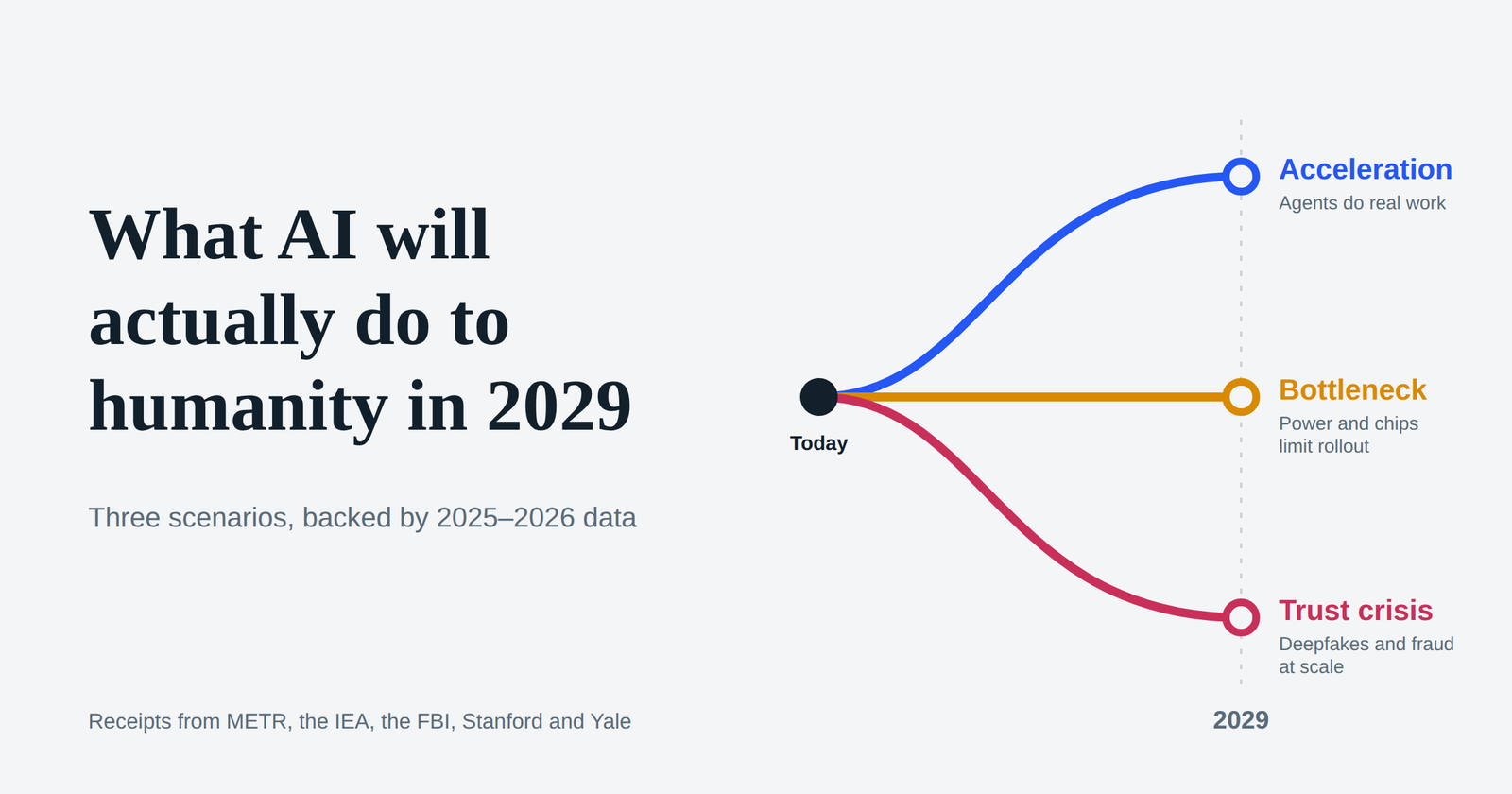
Below are three scenarios backed by 2025–2026 data, an honest read on the uncertainty, and a plan you can start this week.
The Short Answer: What AI Will Actually Do to Humanity in 2029

By 2029, AI will most likely act like a strong but uneven co-worker: great at long digital tasks, held back by power and chip supply, and abused by fraudsters at scale. Expect a messy blend of three paths, not one clean outcome.
That’s the most honest framing of what AI will actually do to humanity in 2029, because even full-time forecasters disagree by decades.
The AI Futures Project, the team behind the viral “AI 2027” scenario, said in its August 2026 update that real progress looks roughly 70–90% as fast as their scenario predicted.
The spread inside that one team is wild. Co-author Daniel Kokotajlo’s median date for an “Automated Coder” is November 2027, while co-author Eli Lifland’s is January 2030, with his 90th-percentile date stretching to 2070. Same team, same data, a 40-year gap. Lowkey, that’s the most important number in this article.
AI agent (definition): An AI agent is software built on a large language model that can plan and carry out multi-step tasks, such as browsing, writing code, filling forms, or calling other tools, with limited human input.
Unlike a chatbot that answers one prompt, an agent works toward a goal and checks its own progress along the way.
Scenario 1: The Acceleration Path (Agents Do Real Work)
In the acceleration path, AI agents reliably handle day-long digital projects by 2029, and the core human job becomes setting goals, reviewing output, and owning results.
This is the optimistic version of what AI will actually do to humanity in 2029, and the evidence for it is stronger than ever, but reliability is still the catch.
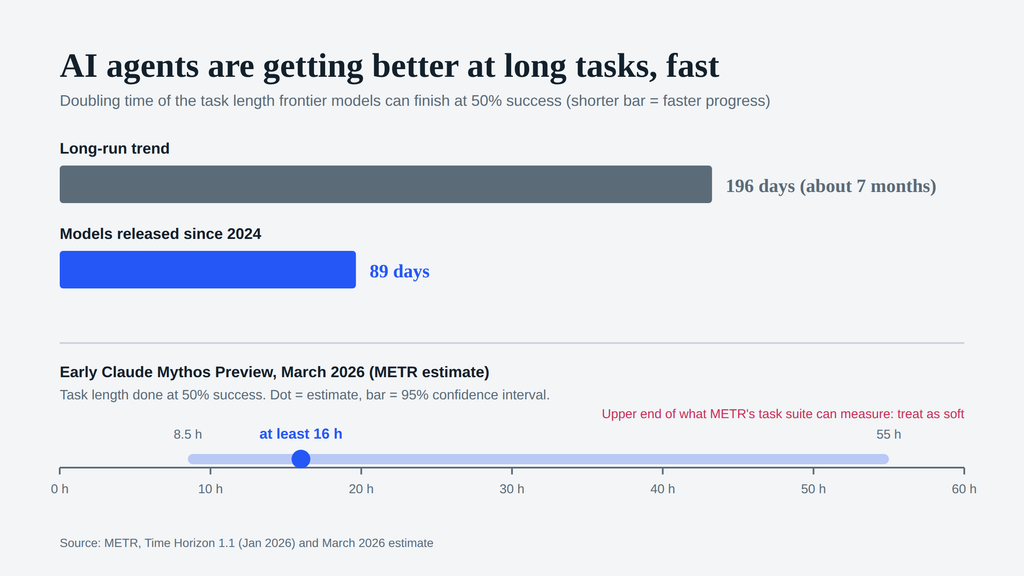
The best single measure here is METR’s time horizon research. Its Time Horizon 1.1 update from January 2026 estimated a long-run doubling time of about 196 days (roughly 7 months), shrinking to about 89 days for models released since 2024.
In March 2026, METR estimated that an early version of Claude Mythos Preview had a 50% time horizon of at least 16 hours, with a 95% confidence interval of 8.5 to 55 hours.
METR flagged that this sits at the upper end of what its task suite can measure, and its Time Horizon 1.1 notes say human baseline times were measured for only 5 of the suite’s 31 tasks lasting 8 hours or more, so treat the exact figure as soft.
Time horizon (definition): METR’s time horizon is the length of a task, measured by how long a skilled human needs to finish it, that an AI model completes successfully 50% of the time.
A 16-hour horizon means the model succeeds about half the time on work that takes an expert two full working days.
Stanford’s 2026 AI Index backs the speed story: scores on the SWE-bench Verified coding benchmark rose from 60% to near 100% in one year, and agents on the OSWorld computer-use test jumped from about 12% to roughly 66% task success.
Yet the top model reads analog clocks correctly only 50.1% of the time. That’s the jagged frontier in one stat.
Science is the most exciting corner. The 2024 Nobel Prize in Chemistry honored AlphaFold’s protein structure work, and Insilico Medicine’s AI-discovered drug rentosertib reported Phase 2a results in Nature Medicine in June 2025 (71 patients, 12 weeks) before moving into Phase III in China.
Here’s the honest part: that flagship drug still has to clear Phase III before any regulator approves it. If someone says what AI will actually do to humanity in 2029 is shrink medicine development from a decade to a few months, that’s a pitch, not a forecast. 🚀 AI speeds up discovery; human trials still run on human time.
Scenario 2: The Bottleneck Path (Power, Chips, Water, and the Verification Tax)
In the bottleneck path, AI keeps improving but rollout slows because grids, chip factories, and cooling systems can’t scale as fast as demand, and human checking eats into promised savings. This version of what AI will actually do to humanity in 2029 is already partly visible in 2026 data.
Start with electricity. The IEA’s Energy and AI report estimates data centres used about 415 TWh in 2024 and projects roughly 945 TWh by 2030, slightly more than Japan uses today. Demand from AI-optimised data centres is projected to more than quadruple, and data centres drive almost half of US demand growth.
Keep it in proportion, though. The IEA also says data centres account for only around one-tenth of global electricity demand growth to 2030, less than air conditioning or electric vehicles. Its 2035 range runs from 700 to 1,700 TWh, which shows how uncertain even the best modelers are.
The local pain is real fr. In PJM, the largest US grid operator, the December 2025 capacity auction cleared at a record $333.44/MW-day price cap for the third auction in a row and still fell about 6,625 MW short of its reliability target.
PJM’s independent market monitor attributed $6.3 billion of that auction’s $16.4 billion cost to data centres.
Water and chips add two more limits. The IEA puts data-centre water consumption at roughly 560 billion litres a year, potentially reaching about 1,200 billion litres by 2030. Stanford’s AI Index notes that one company, TSMC, fabricates almost every leading AI chip, which makes the supply chain fragile.
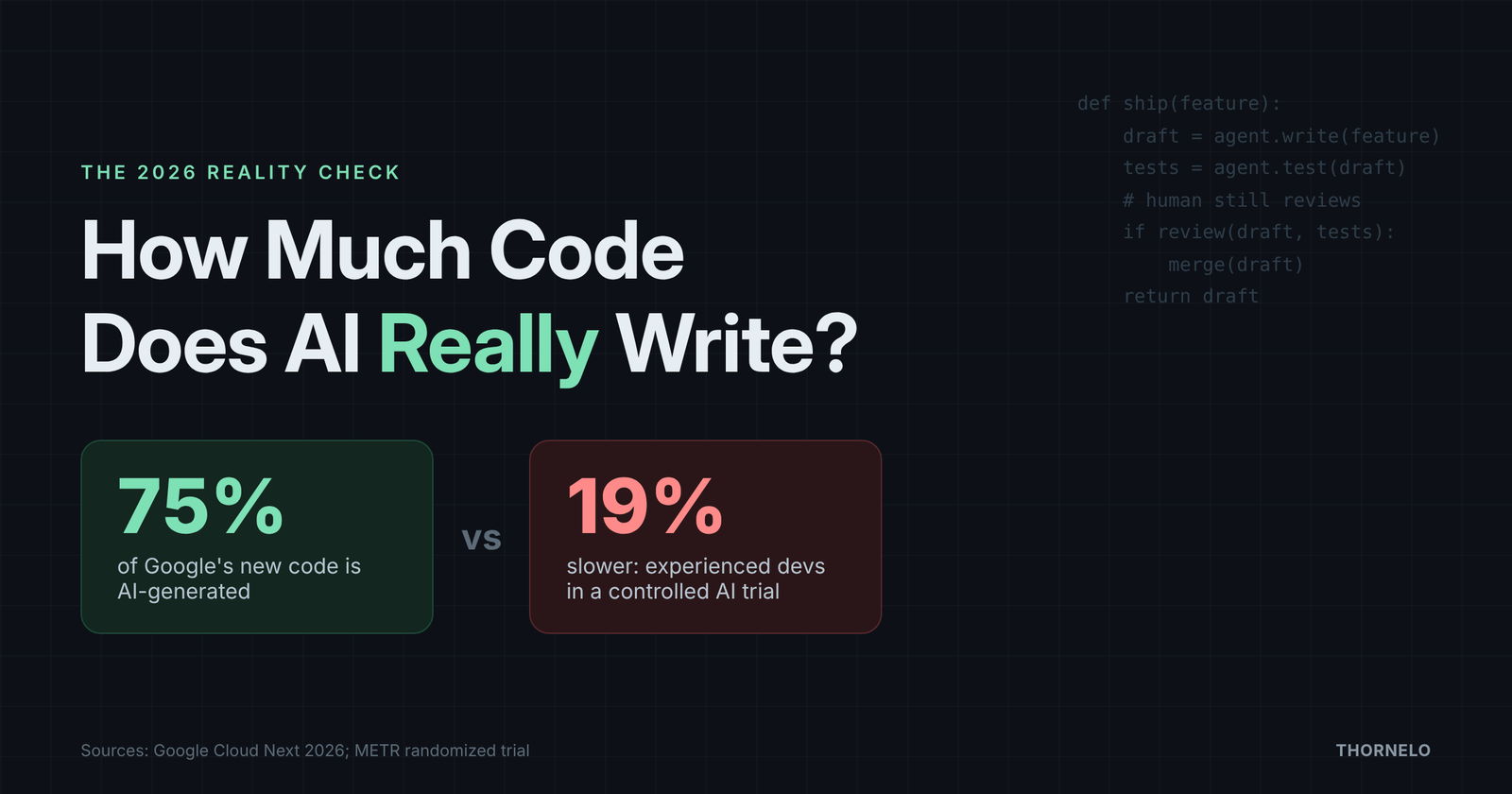
Then there’s the human side. In METR’s 2025 randomized trial, 16 experienced open-source developers working on 246 real tasks took 19% longer with AI tools while believing they were about 20% faster. Tools have improved since, but the lesson sticks: checking AI work costs real time.
Verification tax (definition): The verification tax is the time and money spent checking, fixing, and approving AI output before it can be trusted. When it’s high, as with legal filings, medical notes, or production code, AI’s headline speed gains shrink, and experienced reviewers become more valuable rather than less.
If this path wins, what AI will actually do to humanity in 2029 looks boring in a good way: efficient smaller models on phones and laptops, AI as a utility, and strong hiring in grids, power, and chips.
Scenario 3: The Trust Crisis Path (Deepfakes, Fraud, and Tech Blocs)

In the trust crisis path, cheap synthetic voice and video make “seeing is believing” obsolete, fraud costs climb, and governments respond with provenance rules and tighter tech controls.
Of the three versions of what AI will actually do to humanity in 2029, this one has the hardest current numbers behind it.
The FBI’s 2025 Internet Crime Report recorded 1,008,597 complaints and $20.877 billion in reported losses, up 26% from 2024.
For the first time, it included an AI section: 22,364 complaints and nearly $893 million in losses. People aged 60 and over reported about $7.75 billion in losses overall.
Corporate fraud already crossed the deepfake line. In January 2024, an employee in engineering firm Arup’s Hong Kong office made 15 transfers totaling HK$200 million (about $25 million) after a video call in which the “executives” were deepfakes.
Family scams hit closer to home. The FTC warns that a scammer needs only a short audio clip of a loved one’s voice, often taken from content posted online, plus a voice-cloning program. Its core advice: hang up and call the person back on a number you already know.
Content provenance (definition): Content provenance is a tamper-evident record attached to a photo, video, or audio file that shows where it came from and how it was edited.
The C2PA standard, shown to users as Content Credentials, uses cryptographic signatures so apps can confirm a file’s origin, although a missing credential doesn’t prove a file is fake.
Adoption is real but patchy. Google’s Pixel 10 signs every photo from its built-in camera app with Content Credentials by default, while Samsung’s Galaxy S25 adds them only to images edited with Galaxy AI. Most media you scroll past still carries no credential.
Regulation runs on a staggered clock. The EU AI Act‘s general-purpose AI rules have applied since August 2, 2025, and its transparency duties started August 2, 2026, with the marking rule for AI-generated content (Article 50(2)) given extra time until December 2, 2026.
The Digital Omnibus, Regulation (EU) 2026/1744, in force since July 27, 2026, moved stand-alone high-risk rules to December 2, 2027 and product-embedded ones to August 2, 2028.
Geopolitics is the last piece. In January 2026, the US moved exports of Nvidia’s H200 and similar chips to China to case-by-case licensing with security conditions, and in May 2026 the Commerce Department clarified that license rules also cover China-headquartered firms operating abroad.
Nvidia’s FY2026 annual report said it was “effectively foreclosed” from China’s data-centre compute market.
Yet Stanford’s AI Index found the US–China model performance gap has nearly closed, with the top US model ahead by just 2.7% as of March 2026. So the “AI cold war” is partly real, showing up as rival chip and model ecosystems rather than a full internet split. In this path, what AI will actually do to humanity in 2029 is make verification a daily life skill.
What AI Will Actually Do to Humanity in 2029 at Work
At work, what AI will actually do to humanity in 2029 is most likely shrink the pool of classic entry-level tasks before it shrinks total jobs. The strongest evidence shows young workers in AI-exposed roles losing ground, while economy-wide data still shows no clear disruption.
The Stanford Digital Economy Lab paper “Canaries in the Coal Mine?” by Erik Brynjolfsson, Bharat Chandar, and Ruyu Chen (August 2025), based on ADP payroll data, found a 13% relative employment decline for 22- to 25-year-olds in the most AI-exposed occupations, such as software development and customer service, after controlling for firm-level shocks.
The Canaries Dashboard reports those declines have persisted and deepened, with muted signs reaching workers up to age 34.
Now the counterweight. The Yale Budget Lab’s September 15, 2026 update, using August 2026 Current Population Survey microdata, found no clear evidence of AI-linked labor market disruption across the US economy, with occupational churn, AI exposure among the unemployed, and usage data all flat, within historical ranges, or following pre-AI trends. Both can be true: a squeeze at the entry door, stability in the building overall.
Globally, the ILO estimates one in four workers holds a job with some generative AI exposure, but only 3.3% of global employment sits in the highest-exposure category, and it calls job change, not replacement, the most likely impact.
The IMF estimates almost 40% of global employment is exposed to AI, rising to about 60% in advanced economies.
The World Economic Forum’s Future of Jobs Report 2025 projects 170 million jobs created and 92 million displaced by 2030, a net gain of 78 million, with employers expecting 39% of key skills to change. These are employer expectations, not guarantees.
The honest limits matter. “Exposure” measures tasks AI could touch, not jobs that will vanish, and most hard data comes from the US. Interest rates, hiring freezes, and layoffs blamed on AI for PR reasons all muddy the signal. If you’re job-hunting, our breakdown of how tech hiring works right now shows what recruiters actually screen for.
Which Scenario Should You Plan For?
Plan for all three, weighted by your own exposure. The most likely 2029 has fast agents, expensive power, and widespread fraud at the same time, so the smart move is a plan that works in every path.
| Scenario | What 2029 looks like | Evidence today | Who gains | Who’s at risk |
|---|---|---|---|---|
| Acceleration | Agents finish multi-day digital projects | METR time horizons doubling; coding benchmarks near saturation | People who direct and review AI work | Routine junior digital tasks |
| Bottleneck | AI becomes a utility; small local models spread | IEA power projections; PJM shortfall; 19% slowdown trial | Reviewers, energy and chip workers | Firms betting on instant savings |
| Trust crisis | Provenance checks everywhere; rival tech blocs | FBI’s $893M AI-related losses; deepfake fraud; export controls | Security, fraud, and compliance roles | Older adults, finance teams |
Here’s the decision rule for what AI will actually do to humanity in 2029. If you’re a student, prioritize the acceleration path and learn to direct agents. If you’re a freelancer, sell into the trust and bottleneck paths with verification and security services. If you’re early-career, build proof that you can review AI work and own outcomes, because hiring managers in all three paths pay for that.
Your 2026–2029 Action Plan (Students, Freelancers, Early-Career)
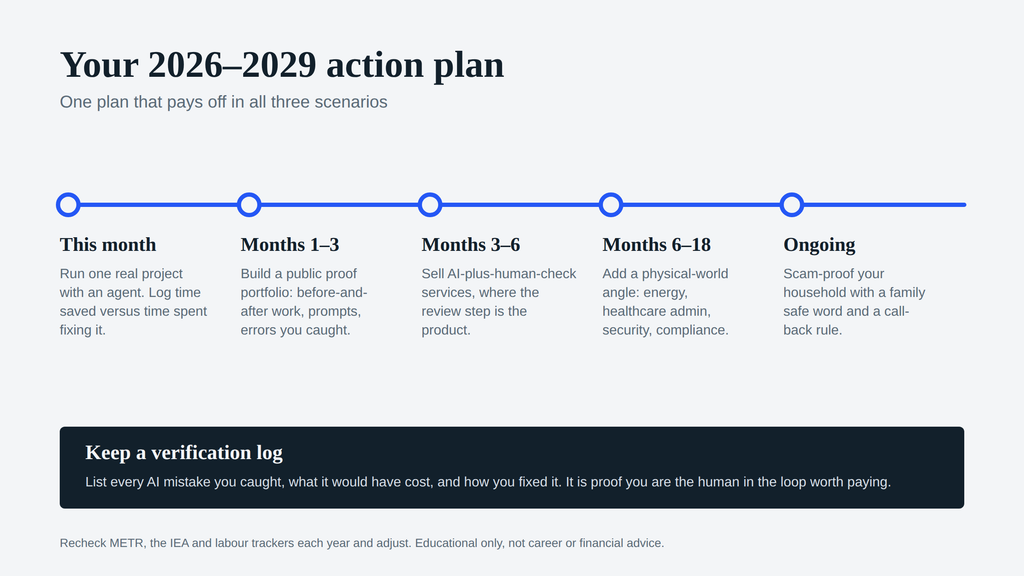
The best response to what AI will actually do to humanity in 2029 is a plan that pays off in all three paths: use agents daily, get good at checking them, and attach yourself to real-world problems. Here’s the roadmap.
- This month: run one real project with an agent. Pick ChatGPT, Claude, or Gemini, give it a multi-step task you’d normally do yourself, and log time saved versus time spent fixing it. All three offer free tiers, so your cost can start at $0.
- Months 1–3: build a public proof portfolio. Show before-and-after work, your prompts, and the errors you caught. Our guide to building a developer portfolio with no experience works for non-coders too.
- Months 3–6: sell “AI + human check” services. Offer AI-assisted research, content, or QA where the review step is the product. Illustrative math: 4 clients × $250/month = $1,000/month. Start with our Fiverr profile guide for CS students or this plan to earn $500 a month as a student. 💸
- Months 6–18: add a physical-world angle. Energy, healthcare admin, cybersecurity, and compliance all need people who understand both AI and the messy real world.
- Ongoing: scam-proof your household. Set a family safe word, adopt a call-back rule for any money request, and never pay by gift card or crypto on an “urgent” request from a boss or relative.
- Yearly: recheck the data. Revisit METR, the IEA, and labor trackers each year and adjust your bets. For bigger-picture money moves, see our 5 ways to get rich in the AI era.
Pro tip competitors skip: keep a “verification log,” a simple doc listing every AI mistake you caught, what it would have cost, and how you fixed it. In interviews and client pitches, that log is hard proof that you’re the human in the loop worth paying, which is exactly what every scenario rewards.
This section is educational and not professional career, financial, or legal advice.
Mistakes to Avoid
The biggest mistake when preparing for what AI will actually do to humanity in 2029 is betting everything on a single scenario. These are just as costly:
- Ignoring AI because it’s “overhyped.” The labor data already shows entry-level pressure in exposed roles.
- Trusting AI output blindly. The METR trial shows people overestimate their own AI speedups.
- Assuming no Content Credential means fake. Most real media still carries none.
- Chasing “AI-proof” job lists. Exposure shifts as models improve, so build skills that travel across roles.
Red Flags in AI Future Hype
Most content about what AI will actually do to humanity in 2029 fails one test: it states dates and dollar figures with more certainty than the people building the systems have. Use these red flags to filter it.
Be skeptical of anyone who gives an exact year for superintelligence, since even the AI 2027 authors’ own forecasts span decades.
Doubt claims that AI will cut drug development to months, because clinical trials still set the pace. Walk away from courses promising “$10,000/month with AI agents” or any guaranteed income.
Watch for deepfake detectors that claim 100% accuracy, and for layoffs blamed on AI with no detail on what was automated.
No cap, the honest answer to what AI will actually do to humanity in 2029 includes “we don’t know yet” more often than hype sellers would like. 🔥
Is there a clear answer to what AI will actually do to humanity in 2029?
No single answer exists, and anyone promising a precise answer to what AI will actually do to humanity in 2029 is guessing. The evidence points to a mix of three paths: faster AI agents, physical limits on power and chips, and more AI-enabled fraud. Plan for all three instead of betting on one.
Will AI take my job by 2029?
AI is more likely to change your job than delete it, but entry-level roles in highly exposed fields face the most pressure. Stanford researchers found a 13% relative employment decline for 22- to 25-year-olds in the most AI-exposed occupations, while Yale’s tracker sees no economy-wide disruption yet. Your best defense is proving you can direct and verify AI work.
Will we have AGI by 2029?
Nobody knows. In August 2026, the AI 2027 authors’ median forecasts for an “Automated Coder” ranged from November 2027 to January 2030, with long tails beyond that. Treat any confident AGI date as opinion, not fact.
Will AI deepfake scams get worse?
The trend points that way. The FBI recorded 22,364 AI-related complaints and nearly $893 million in losses in 2025, the first year its annual report included an AI section. A family safe word and a call-back rule on known numbers are the cheapest protections.
Will AI cause electricity shortages?
Not globally, but some local grids are already strained. The IEA projects data-centre electricity use reaching about 945 TWh by 2030, and the PJM grid in the US fell short of its reliability target in its December 2025 auction. Expect higher power prices in data-centre hotspots before outright shortages.
What skills will matter most by 2029?
If you’re preparing for what AI will actually do to humanity in 2029, focus on directing AI agents, checking their output, security awareness, and domain knowledge in fields like energy, healthcare, and compliance. The WEF expects 39% of key job skills to change by 2030. People who pair AI fluency with real-world judgment will have the widest options.
Is the EU AI Act fully in force yet?
Not yet. General-purpose AI rules have applied since August 2025 and transparency duties since August 2026, but the Digital Omnibus moved high-risk obligations to December 2, 2027 and August 2, 2028. By 2029, most of the Act should apply.
Will AI cure diseases by 2029?
AI will speed up research, but cures still depend on clinical trials. Insilico’s AI-discovered drug rentosertib reached Phase III in China after positive Phase 2a results in Nature Medicine, yet it isn’t approved. Expect more AI-found drug candidates in trials by 2029, not a wave of instant cures.
What AI Will Actually Do to Humanity in 2029 Depends on Your Prep
What AI will actually do to humanity in 2029 is less a single event than a set of pressures: smarter agents, pricier power, and smarter scams, all hitting at once. The data says entry-level digital work changes first, verification becomes a premium skill, and physical-world problems keep paying.
Your one next step: this week, hand one real task to an AI agent, time it, and write down every mistake you catch. That’s day one of your verification log, and it’s the habit that pays off no matter which version of what AI will actually do to humanity in 2029 shows up.

Leave a comment