
Google just dropped its third Flash model in six weeks, searchenginejournal and no cap, this one matters if you code, freelance, or study on a tight budget.
Gemini 3.8 Flash launched on September 2, 2026 as Google’s smartest Flash model so far, at $0.75 per million input tokens and $3.75 per million output tokens through the end of 2026.
This guide covers what it is, who can use it right now, what it will cost after the promo, how the new voice models with voice cloning fit in, and how to turn it into real work. Everything here is checked against Google’s own pages as of October 1, 2026.
What Is Gemini 3.8 Flash?
Gemini 3.8 Flash is Google’s newest mid-tier “workhorse” AI model, tuned for long coding tasks, AI agents, and multi-step reasoning at Flash-level speed and cost. It sits between the cheap Flash-Lite models and the heavier Pro models in the Gemini 3 family.
Google’s model card says it is “based on Gemini 3.7 Flash,” so think of it as a sharper second pass rather than a brand-new brain.
The big design change is effort: Google says 3.8 Flash “works harder,” blog running extra reasoning steps and calling tools repeatedly before it lands on an answer.
Google also released a security version called 3.8 Flash Cyber for vulnerability detection and patching. That one is not public. It goes only to vetted defenders through Google’s Fairwind Program, so most readers can skip it.
One limit to keep in mind: the knowledge cutoff is March 2026, and Google notes some domains may only reflect January 2025 knowledge.For anything recent, turn on Search grounding or paste in your own sources.
Where Is Gemini 3.8 Flash Available Right Now?
You can use Gemini 3.8 Flash in the Gemini app, AI Mode in Google Search, and Google Sheets with a Google AI Pro or Ultra plan, or through the Gemini API, Google AI Studio and Google Antigravity as a developer.
Here’s the breakdown by who you are.
Everyday users: Google’s launch announcement lists the Gemini app, AI Mode and Gemini in Google Sheets for Google AI Pro and Ultra subscribers.Google AI Pro costs $19.99 a month in the US.
In AI Mode, you pick the model from the “+” icon in the “Ask anything” bar. Robby Stein, VP of Product for Google Search, confirmed it was “available today in AI Mode for Google AI Pro & Ultra subs around the world.”
Search Engine Journal reported that “free-tier AI Mode users don’t get a model choice”; they get Google’s default, and Google hasn’t announced 3.8 Flash as that default.
Developers: It’s live in the Gemini API through Google AI Studio, Android Studio, the Stitch UI tool, and Google Antigravity, theregister Google’s agent-first coding environment. The model ID is gemini-3.8-flash, and it’s a stable release, not a preview.
Businesses: It’s generally available on Google Cloud’s Gemini Enterprise Agent Platform. The Gemini Enterprise app switched it on by default on September 23, 2026 in the global, US and EU regions.
Students: Google is offering eligible US college students a free year of Google AI Pro, and students in more than 140 other countries a free year of Google AI Plus, with sign-ups open through December 31, 2026.
Only Pro and Ultra are on Google’s list for 3.8 Flash, so non-US students should lean on the free AI Studio route. 🎓
Heads-up: on September 30, 2026, Google announced Gemini 4 Argon, its new frontier model. It’s rolling out first to cyber defenders, with paid API customers and Ultra subscribers next, and there’s no public date yet.For now, 3.8 Flash stays the practical daily pick.
How Much Does Gemini 3.8 Flash Cost?
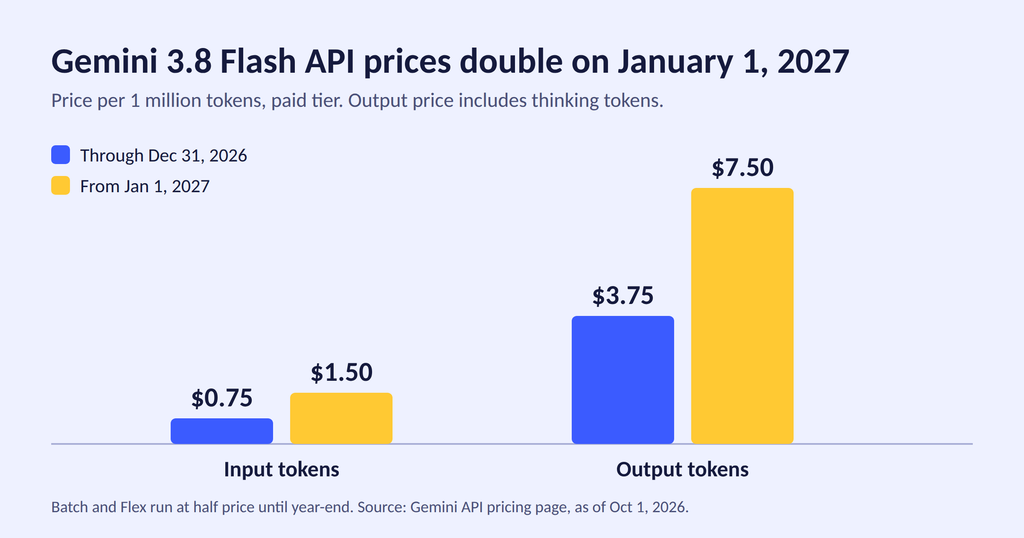
On the Gemini API’s paid tier, it costs $0.75 per million input tokens and $3.75 per million output tokens through December 31, 2026, then doubles to $1.50 and $7.50 from January 1, 2027. Output pricing includes the model’s thinking tokens.
The Gemini API pricing page also lists these rates worth knowing:
- Free tier: input and output are free of charge within rate limits, but Google uses free-tier content to improve its products.2
- Batch and Flex: half price, $0.375 input and $1.875 output per 1M tokens until year-end.
- Context caching: $0.075 per 1M cached tokens until year-end.
- Google Search grounding: 5,000 free requests a month shared across Gemini 3.x models, then $14 per 1,000.
What does that mean in plain money? Here’s illustrative math. Say you summarize 100 client PDFs of 20,000 tokens each: that’s 2 million input tokens, or $1.50. If each summary plus thinking uses 5,000 output tokens, that’s 500,000 output tokens, or about $1.88.
Total: roughly $3.40 for the whole batch today, or about $6.75 at 2027 rates. 💸
The hidden cost is token appetite. Independent tester Artificial Analysis found 3.8 Flash on high reasoning cost $0.58 per evaluation task versus $0.40 for 3.7 Flash, about 40% more, driven by a 30% increase in average output tokens per task to 48,000 and more turns on agentic evaluations. Same sticker price, bigger bill.
Gemini 3.8 Flash Benchmarks: What the Numbers Actually Say
Gemini 3.8 Flash clearly beats 3.7 Flash and matches or leads pricier models on several coding and finance tests, but it still trails top frontier models on general agent and computer-use tasks. That’s the honest summary.

From the Google DeepMind model card:
- DeepSWE v1.1 (long-horizon software engineering): 73.7%, up from 65.3% on 3.7 Flash and close to Claude Opus 5 at 74.0%.
- Terminal-bench 2.1 (agentic terminal coding): 89.4%, the top score in Google’s table.
- Vals Finance Agent v2: 61.4%, ahead of every model Google compared.
- HLE-Verified (expert reasoning): 54.9%.
- OSWorld-2.0 (computer use): 59.0%, well behind Claude Opus 5 at 75.4%.
- Terminal-bench 4.0 (general agent skills): 19.1%, versus 51.8% for Claude Opus 5.
Independent scores back up the “solid upgrade, not magic” vibe. Artificial Analysis rates 3.8 Flash at 59 on its Intelligence Index with high reasoning, up 3 points from 3.7 Flash’s 56 and on par with GPT-5.6 Sol (xhigh) and Grok 4.6 (medium), and calls it the cheapest model at that intelligence level.
At launch on September 2, 2026, Artificial Analysis measured about 300 output tokens per second on high reasoning, with about 2.5 minutes per task versus 2.2 minutes for 3.7 Flash. Remember these are lab benchmarks, not your workload, and the model card itself warns about hallucinations, “occasional slowness or timeout issues,” and higher token use at higher effort levels.
Gemini 3.8 Flash vs 3.7 Flash, Flash-Lite and Pro
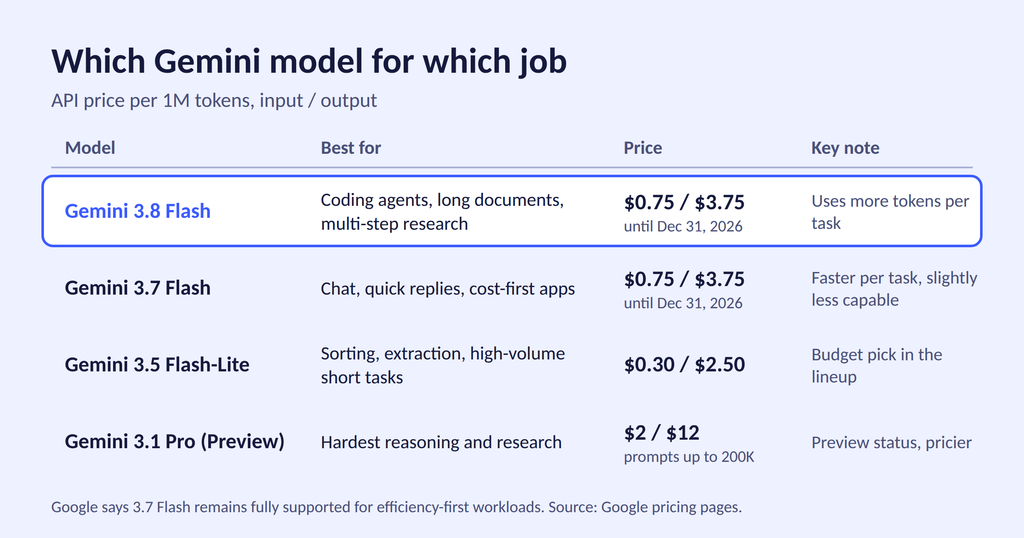
Pick 3.8 Flash for hard multi-step work, keep 3.7 Flash for speed-first or cost-first jobs, use Flash-Lite for bulk simple tasks, and save Pro-class models for the toughest reasoning. Google itself says 3.7 Flash “remains fully supported for efficiency-first workloads.”
| Model | Best for | API price per 1M tokens (input / output) | Key note |
|---|---|---|---|
| Gemini 3.8 Flash | Coding agents, long documents, multi-step research | $0.75 / $3.75 until Dec 31, 2026 | Higher token use per task |
| Gemini 3.7 Flash | Chat, quick replies, cost-first apps | $0.75 / $3.75 until Dec 31, 2026 | Faster per task, slightly less capable |
| Gemini 3.5 Flash-Lite | Sorting, extraction, high-volume short tasks | $0.30 / $2.50 | Budget pick in the current lineup |
| Gemini 3.1 Pro (Preview) | Hardest reasoning and research | $2 / $12 (prompts up to 200K) | Preview status, pricier |
Gemini 3.8 Flash TTS and Flash-Lite TTS: The New Voice Models
On September 23, 2026, Google launched two text-to-speech models, Flash TTS and Flash-Lite TTS, that design voices from text prompts, direct delivery line by line, and can replicate a real voice from a 30-second sample with consent. These are separate audio models, not features of the text model.
Google’s text-to-speech announcement splits the two like this:
- Flash TTS is for creative work like games, audiobooks and podcasts. It designs voices from prompts in 100+ languages and dialects, offers 2,000+ ready-made voices, and supports two-speaker scenes plus tags like
<laughs>and<sigh>. - Flash-Lite TTS is for scale: dubbing, bulk audio and voice agents, at a lower price.
Pricing is per token, and Google bills audio at 25 tokens per second. On the paid tier, Flash TTS is $0.50 per 1M text tokens in and $9 per 1M audio tokens out, while Flash-Lite TTS is $0.50 in and $6 out.
That works out to roughly $0.81 per hour of Flash TTS audio and $0.54 per hour on Flash-Lite, until both double on January 1, 2027.
Google’s docs say the reference clip should run 10 to 30 seconds, and the consent clip must recite a set statement such as “I am the owner of this voice and I consent to Google using this voice to create a synthetic voice model.” Replicated voices also carry C2PA content credentials.
Big regional catch: Google says voice replication through AI Studio is not available in Illinois, Texas, the EEA, the UK, Switzerland, or India.
Voice remixing is listed as “coming soon,” and Gemini Enterprise API access is still pending too.
Only clone voices you own or have clear permission to use. This is general information, not legal advice, since voice and likeness laws differ by country and state.
For non-coders, Flash TTS is rolling out in Gemini Notebook and Flash-Lite TTS in Google Vids, so you can try the voices without touching an API.
How to Start Using Gemini 3.8 Flash Today
The fastest free route is Google AI Studio: sign in, pick gemini-3.8-flash, and test a real task before you pay for anything. Here’s a simple roadmap.
- Pick your door. Chat users with AI Pro or Ultra open the Gemini app or AI Mode. Builders go to Google AI Studio.
- Run one real task twice. Use something you actually do, like turning lecture notes into a study guide or reviewing a pull request.
- Test the thinking levels. The model supports low, medium (the default) and high; “minimal” isn’t supported and returns an error. Start on low for simple jobs.
- Turn on grounding when facts matter. Use Google Search grounding for anything after the March 2026 cutoff.
- Link billing only when you outgrow the free limits. Free-tier limits show inside AI Studio, and paid use starts once billing is connected.
- Budget at 2027 prices. If a project runs past December 31, plan with $1.50 / $7.50.
Developers moving from 3.7 Flash mostly just swap the model string, and Google’s Cloud developer guide covers the migration details.
7 Powerful Ways to Use Gemini 3.8 Flash for School, Freelancing and Business
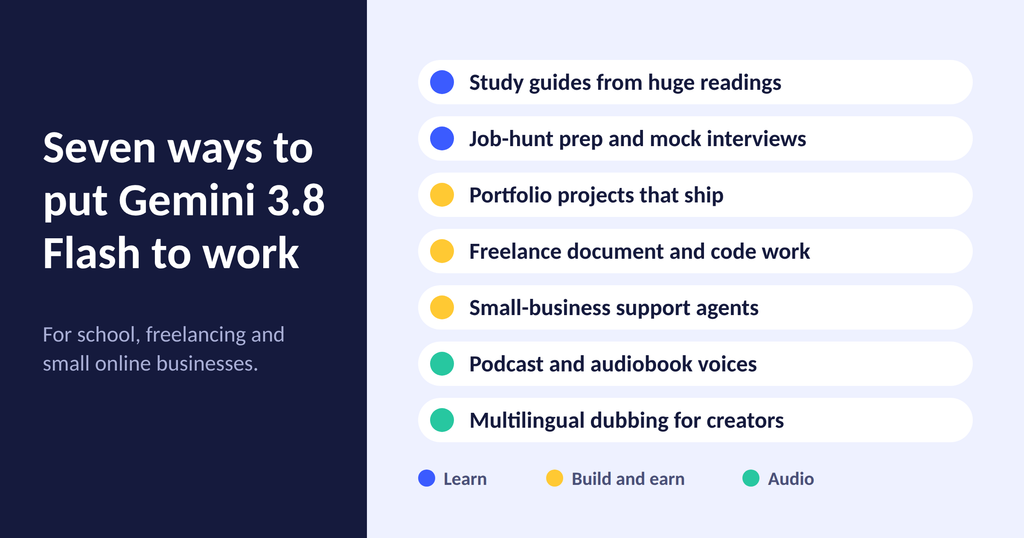
The best uses play to its strengths: long inputs, multi-step coding, careful document analysis and, with the TTS models, voice work. Here are seven that fit students, freelancers and small online businesses.
- Study guides from huge readings. The 1M-token window can hold a semester’s worth of PDFs. Ask for practice questions, then check answers against the source.
- Portfolio projects that actually ship. Build and debug real apps in Antigravity or AI Studio, then document what you made. Our guide to a developer portfolio with no experience shows how to present them.
- Freelance gigs with an AI edge. Offer document summaries, data cleanup in Sheets, or code reviews. If you’re setting up on a marketplace, see how to build a Fiverr profile as a CS student.
- Podcast and audiobook voice work. Flash TTS handles two-speaker scenes and long-form narration with minimal speaker drift, according to Google.
- Multilingual dubbing for creators. Flash-Lite TTS is built for high-volume dubbing across 100+ languages.
- Small-business agents. Build a support or lead-qualification bot with function calling and grounding, then sell it as a monthly service.
- Job-hunt prep. Paste a job description and your resume, then ask for a gap analysis and mock interview questions. It pairs well with our breakdown of how tech hiring works now.
Illustrative earnings math, not a promise: 3 podcast clients x $150/month for AI-voiced intros = $450/month, while 10 hours of Flash TTS audio costs about $8 at current rates. For more side-income ideas, read how to earn $500 a month as a student and our take on ways to build wealth in the AI era.
Which One Should You Pick?
Most people should start with Gemini 3.8 Flash on the free AI Studio tier, then switch models only when cost or speed forces it. Use this quick filter:
- Student on a budget: free AI Studio, or the free AI Pro year if you’re an eligible US college student.
- Freelancer doing document or coding work: 3.8 Flash on low or medium thinking.
- App with lots of short, simple calls: 3.5 Flash-Lite or 3.7 Flash.
- Creator making audio: Flash TTS for quality, Flash-Lite TTS for volume.
- Hardest research or reasoning: a Pro-tier model, or wait for Gemini 4 Argon’s wider release.
Common Mistakes
3.8 Flash is a strong, cheap model, not a guaranteed money machine, and the biggest risks are surprise bills, made-up facts, and voice-cloning misuse. Watch for these:
- Shady “lifetime access” deals. Stick to Google’s own apps, AI Studio, or reputable API providers rather than resold or shared accounts.
- Ignoring the price jump. Rates double on January 1, 2027, so quote clients accordingly.
- Running everything on high. Artificial Analysis measured $0.24 per task on low, $0.41 on medium and $0.58 on high, and time per task fell from 2.5 minutes on high to 0.8 minutes on low.
- Trusting it blindly. A September 2026 thread on the Google AI Developers Forum reported that the model “frequently presents old or incorrect information with high confidence,” and the model card lists hallucinations as a known limitation.
- Cloning voices without consent. Beyond Google’s checks, it’s an ethical and legal minefield.
- Putting private data on the free tier. Free-tier content is used to improve Google products; paid-tier content is not.
Pro Tip Most Guides Skip
Log the model name and thinking level with every result you save or ship. Google released three Flash models in six weeks, and Search Engine Journal’s Matt G. Southern noted that “the options in a paid AI Mode test can change inside a single reporting cycle.”
If you sell AI-made work, a one-line note like “gemini-3.8-flash, medium, Oct 2026” makes quality issues easy to trace and re-runs easy to price. Lowkey the most underrated habit in AI freelancing. 🔍
FAQ
Is Gemini 3.8 Flash free?
Yes, in a limited way. The Gemini API free tier in Google AI Studio covers the model’s input and output within rate limits, but Google uses that content to improve its products. In the Gemini app, you need Google AI Pro or Ultra.
When was Gemini 3.8 Flash released?
Google released it on September 2, 2026, alongside a security version called 3.8 Flash Cyber. It arrived about three weeks after Gemini 3.7 Flash and was added to AI Mode in Search the same day.
How much does the Gemini 3.8 Flash API cost?
It costs $0.75 per 1M input tokens and $3.75 per 1M output tokens through December 31, 2026. From January 1, 2027, the price rises to $1.50 and $7.50, and output pricing includes thinking tokens.
What is the Gemini 3.8 Flash context window?
It accepts up to 1,048,576 input tokens and can output up to 65,536 tokens. Inputs can be text, images, video, audio and PDFs, while output is text only.
Can Gemini 3.8 Flash TTS clone my voice?
Yes, the Flash TTS model can replicate a voice from a sample of about 30 seconds if you own the voice or have the rights to it. The voice owner must record a matching consent statement, and AI Studio replication isn’t available in Illinois, Texas, the EEA, the UK, Switzerland or India.
Is Gemini 3.8 Flash better than Gemini 3.7 Flash?
On Google’s published benchmarks, yes, especially for long coding and agent tasks, such as 73.7% versus 65.3% on DeepSWE v1.1. It also uses more tokens and time per task, so 3.7 Flash can still be the smarter pick for fast, simple jobs.
Is Gemini 3.8 Flash available in AI Mode for free users?
Not as a selectable option. Google AI Pro and Ultra subscribers can choose it from the “+” menu in AI Mode, while Search Engine Journal reports that free-tier users get no model choice, only Google’s default.
Conclusion
Gemini 3.8 Flash is Google’s best-value model for real work right now: strong at coding and documents, cheap through 2026, and paired with voice models that make audio projects realistic for small creators. Just budget for the January price jump and the extra tokens it spends thinking.
Your next step: open Google AI Studio today, select gemini-3.8-flash, and run one task you’d normally spend an hour on. If it saves you that hour, you’ve found your new daily driver.
Leave a comment