

Five hundred bucks a month sounds small until you try to fit it between lectures, group projects and a sleep schedule that’s already cooked.
Short answer: yes, you can earn 500 dollars a month as a student, as long as you have about 7–13 spare hours a week, legal permission to work, and you do the fee math before you pick a hustle.
Most “make money in college” posts skip that last part. This one is built on it: real platform fees, real visa hour caps, real payout delays, and the scams that go after students specifically. No cap, the math is the whole game.
Key Takeaways
- $450/month ≈ $104/week. At $8–$15 net per hour, that’s roughly 7–13 hours a week.
- Beginner fees hit hard. Fiverr keeps 20% of every order, Preply keeps 100% of each trial lesson and 33% of your first 20 hours, and Wyzant keeps a flat 25%.
- Your visa sets the ceiling. US F-1 students: 20 hours a week on campus during term. UK Student visa: no self-employment. Canada: 24 off-campus hours a week. Australia: 48 hours a fortnight.
- Plan for 2–6 weeks of ramp-up before your first payout actually clears.
- Anyone asking you to pay, deposit a check, or top up crypto to “release” earnings is a scammer.
What Does It Actually Take to Earn 500 Dollars a Month as a Student?
To earn 500 dollars a month as a student, you need about $104–$115 of net income per week.
Depending on what you keep per hour after fees, that’s 5–13 hours of work. The goal is realistic for most students; the platform choice and the timeline are where people get burned.
Here’s the core concept, in one block:
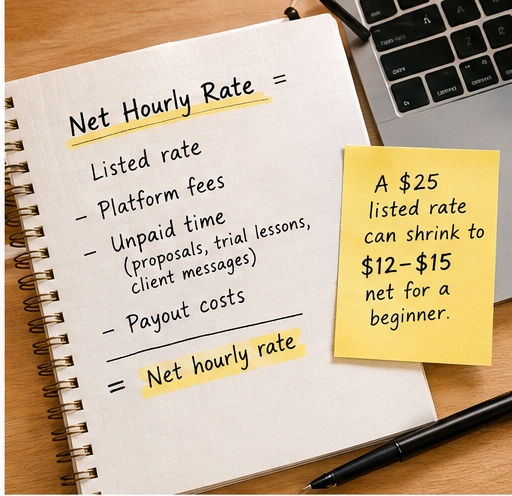
Net hourly rate is what you keep per hour after platform fees, unpaid time (proposals, trial lessons, screener surveys, client messages) and payout costs. It’s the only number that predicts if a side hustle can reach $400–$500 a month. A $25 “listed” rate can easily shrink to $12–$15 net for a beginner.
Working while studying is normal, not a flex. Federal data from the US National Center for Education Statistics shows exactly 40% of full-time undergraduates were employed in 2020, compared with 74% of part-time undergraduates.
The real question is how many hours you can give before your grades pay the price:
the Lumina Foundation, citing NCES, notes that students who worked 25 or more hours a week were less likely to finish a bachelor’s degree within six years, and it cites a University of Wisconsin-Madison study finding that students working more than 20 hours a week were 2.5 times more likely to drop out.
The Honest Math: Hours per Week for $450 a Month
Your hours depend on one variable: net hourly rate. At $8 net you need about 13 hours a week; at $20 net you need about 5. Every figure below is illustrative math using published platform fees, not a claim about what anyone earns.
| Option (illustrative) | Listed rate | Platform cut | Net per hour | Hours/week for ~$450/month |
|---|---|---|---|---|
| Campus job | $13/hr wage (example) | None (payroll tax may apply) | ~$13 | ~8 |
| Preply tutor, new | $20/hr | 33% after the free trial | $13.40 | ~7.8 |
| Wyzant tutor | $30/hr | 25% flat | $22.50 | ~4.6 |
| Fiverr gig ($50 order, 4 hrs of work) | $12.50/hr | 20% | $10 | ~10.4 |
| Upwork contract | $20/hr | 10% example (varies 0–15%) | $18 | ~5.8 |
| AI training, general project | $25/hr advertised start | None listed | ~$25 when work exists | ~4.2 |
| User testing | $10 per 15–20 min test | None | Depends on invites | ~45 tests/month |
See the pattern? The best-paying options (Wyzant, AI training) are the hardest to get into, while the easiest ones (user testing, small gigs) need the most volume. That trade-off is the whole decision, fr.
The Hidden Costs That Shrink Student Earnings

Platform fees, unpaid onboarding and payout delays can cut a beginner’s real earnings by a big chunk and push the first withdrawal two weeks or more into the future. Price for them upfront or the math above falls apart.
On Fiverr, freelancers receive 80% of each order, including extras and tips, and cleared money becomes available 14 days after an order completes (7 days for Seller Plus, Top Rated and Pro freelancers).
So a $50 gig puts $40 in your pocket, two weeks later.
On Upwork, the freelancer service fee has been variable since May 2025, ranging from 0% to 15% per contract and locked in when you send the proposal.
You also spend Connects to apply, which Upwork’s own Help Center prices at $0.15 each, sold in bundles, so every rejected proposal costs a little.
On Preply, the first lesson with every new student carries a 100% commission, meaning you’re paid nothing for it.
After that, commission starts at 33%, drops to 28% after 20 hours, and falls to 18% at 400+ hours.Wyzant keeps a flat 25% platform fee, so you receive 75% of your posted rate.
On UserTesting, the practice test is unpaid, and payments go out via PayPal usually 14 days after a completed test.None of this is shady; it just means your first month is always lighter than your spreadsheet says.
7 Realistic Ways Students Earn $400–$500 a Month in 2026
The most reliable routes are a campus job, online tutoring and skill-based freelancing. AI training work and user testing are solid top-ups, but they’re rarely steady enough to carry the full $450 alone.
1. Campus jobs (the underrated base layer)
Library desks, lab assistant roles, dining halls, IT help desks and research assistant spots have no platform fee, fixed shifts, and bosses who understand exam weeks. For many international students, on-campus work is the only legal option in year one.
Illustrative math: 8 hours × $13 × 4.33 weeks ≈ $450. Check your school’s posted wage rates, since they vary a lot by country and campus.
2. Online tutoring
Tutoring pays well per hour if you know a subject cold. Preply says its English tutors charge $15–$25 per hour on average, and you set your own rate. Wyzant suits academic subjects and test prep.
Illustrative math on Preply at $20/hour and the 33% tier: 4 regular students × 2 hours a week × $13.40 net ≈ $464/month.
The catch is the free trial lesson for every new student, so retention matters more than sign-ups. Tutor what you just aced: intro calculus, chemistry, coding basics, or exam prep.
3. Freelancing on Fiverr or Upwork
Freelancing works when you sell one clear skill: short-form video editing, Canva design, copy editing, slide decks, spreadsheet cleanup or basic website fixes. Both platforms require you to be 18+.
Fiverr allows 13–17-year-olds only through an account owned by a parent or guardian.
Illustrative math: 2 retainer clients × $250/month on Upwork at a 10% fee = $450 net. On Fiverr at 20%, you’d need about $565 in orders to keep $450. Expect the first order to take a few weeks while you have zero reviews.
4. AI training and data annotation
AI training work pays some of the highest advertised hourly rates open to students.
DataAnnotation’s FAQ lists general projects “starting at $25-$30+ per hour,” multilingual projects at $20+, and coding, STEM and professional projects at $50–$100+, paid via PayPal.
The reality check:
its contractor terms require you to be 18+,you need English fluency and a government photo ID, and independent contributor reports usually describe lower real rates, slow or no replies to applications, and work that arrives in waves.
CareerSeeker AIThe AI Rankings An older version of its site listed only the US, Canada, UK, Ireland, New Zealand and Australia, and current pages don’t publish a country list.
DataAnnotationThe AI Rankings Illustrative math: 4 hours a week × $25 × 4.33 ≈ $433, but only in weeks when projects exist.
5. User testing
User testing is the easiest to start and the hardest to scale. UserTesting says reward amounts vary by test type, length and customer demand.
Usertesting Its customer help documentation lists $4 for a 5–7 minute short test, $10 for a 15–20 minute standard test, and $30–$120 for live conversations lasting 30–120 minutes.
You have to pass screener questions for each test, so volume is unpredictable. Illustrative math: 2 one-hour live conversations ($60 each) + 10 standard tests ($10 each) = $220. Nice top-up, not a salary.
6. Local services and gig apps
Babysitting, pet sitting, moving help, in-person tutoring for kids and event staffing pay fast and need no profile or reviews.
Delivery apps can work too, but subtract fuel, phone data and wear on your bike or car before you count anything. Many international students can’t legally use gig apps at all.
7. Reselling and content creation (slow burn)
Reselling textbooks or thrifted clothes and making UGC videos for brands have upside, but month-one income is often close to zero.
Don’t count them toward your $450 target until they’ve paid you for two or three months in a row. 🚀
Check Your Work Rights Before You Earn a Cent
Your visa, not your motivation, sets your ceiling. Several countries count freelance or app-based work toward your hours, and some ban self-employment completely.
United States (F-1): You can work on campus up to 20 hours a week while school is in session and full-time during breaks.
ICE Off-campus work needs specific authorization, as explained on the official Freelancing for outside clients isn’t on-campus work, so talk to your DSO before you open a Fiverr account.
United Kingdom: Degree-level Student visa holders can generally work 20 hours a week in term time (10 below degree level) and full-time in official vacations.
NISAU Student visa conditions don’t allow self-employment or business activity,
Rowanncl and the University of Edinburgh’s Student Immigration Service warns that any work as a freelancer, contractor or consultant is highly likely to count as self-employment, which rules out most Fiverr and Upwork freelancing.
Canada: Eligible students can work up to 24 hours a week off campus during term and unlimited hours during scheduled breaks, per IRCC’s off-campus work rules. Immigration, Refugees and Citizenship Canada Self-employed students must track and prove their own hours. Canada.ca
Australia: Student visa holders can work no more than 48 hours a fortnight while their course is in session and have no limit when it isn’t, as set out in Home Affairs’ work restrictions. Australian Department of Home Affairs
In every country, hours from all jobs add together. NISAU +2 This section is general information, not immigration or legal advice; confirm your own conditions with your international student office.
Taxes: The $400 Line US Students Should Know
In the US, you usually owe self-employment tax once your net earnings from self-employment reach $400 in a year, which means a single month at this goal can cross the line. It applies no matter how old you are. Internal Revenue ServiceInternal Revenue Service
The IRS explains that the tax generally applies to 92.35% of your net earnings, at a combined 15.3% rate (12.4% Social Security plus 2.9% Medicare);
see IRS Topic 554 on self-employment tax. Internal Revenue ServiceIRS Illustrative math: $3,000 of net freelance income × 92.35% × 15.3% ≈ $424, before any income tax.
Easy habit: move about 15% of every freelance payout into a separate savings pot the day it lands. Campus jobs usually withhold tax through payroll, and other countries have their own rules. This is educational, not professional tax advice.
Which Way to Earn 500 Dollars a Month as a Student Should You Pick?

Pick the path that fits your legal status first, your skills second, and how fast you need cash third. Here’s the quick decision guide:
- On an F-1 or UK Student visa: start with a campus job or a regular payroll job; skip freelancing unless your advisor confirms it’s allowed.
- Strong in one subject and can commit fixed weekly slots: online tutoring.
- Have a portfolio-ready skill (editing, design, writing): Upwork or Fiverr.
- Need money within two weeks: campus job or local services.
- Strong writer, coder or STEM student in an eligible country: apply to AI training as a top-up.
- Want zero commitment: user testing, knowing it won’t reach $450 alone.
The winning combo for most people is lowkey boring: one steady base (campus job or tutoring) plus one flexible top-up.
Your 30-Day Roadmap to the First $450
A realistic plan is one main income path, four focused weeks, and a first full $450 month that may not land until month two. Here’s the sequence:
- Week 1 – Set up: Confirm your work rights, pick one main path, build your profile or résumé, and calculate your net hourly rate with the fees above.
- Week 2 – Apply: Send 10 campus job applications, or 15 targeted freelance proposals, or publish a tutor profile with a short intro video.
- Week 3 – Deliver: Do your first paid work, over-deliver slightly, and ask for a review.
- Week 4 – Adjust: Add one more weekly slot or client, raise prices once you have reviews, and add one top-up like user testing.
Track every hour, paid and unpaid, in a simple spreadsheet. Clearance periods (14 days on Fiverr, around 14 days on UserTesting) UserTestingFiverr mean week-four work often pays in week six.
Red Flags: Student Job Scams to Skip
If a “job” asks you to pay upfront, deposit a check and send part of it back, or add your own money to withdraw earnings, it’s a scam.
FTC Consumer AdviceFTC Consumer Advice Students get targeted hard because they’re online, short on cash and new to hiring norms.
The FTC describes task scams where you “earn” commissions for liking videos or rating product images, see fake earnings pile up, maybe get paid $5–$20 to build trust, then get asked to deposit your own money, usually crypto.
FTC Consumer AdviceFTC Consumer Advice Read the FTC’s guide to spotting task scams before you answer any “remote job” text.
Other red flags: an unexpected text asking you to reply “YES,” a recruiter who wants your bank details before an interview,
and any employer who sends a check and asks you to forward part of it. Honest employers never make you pay to get a job. FTC Consumer Advice +2 🔥
Common Mistakes That Keep Students Stuck Under $200
The biggest mistake is running four hustles at once and never getting good at any of them. Others that show up constantly:
- Pricing without subtracting the platform fee.
- Ignoring unpaid time like proposals, trial lessons and screeners.
- Taking extra shifts in exam weeks and burning out.
- Adding up hours across two jobs and quietly breaking a visa cap.
- Counting “pending” money as spendable before it clears.
Pro Tip: Bank Your Breaks
Most student visas and campus rules allow full-time or unlimited work during official breaks, so the smartest way to hit $450 a month is often to earn heavily in breaks and spread that cash across the term.
Hardly any student money guide mentions this.
Illustrative math: 6 weeks of break × 30 hours × $13 = $2,340, which covers more than five months of a $450 top-up.
That lets term-time work drop to 3–5 hours a week, right when your grades need you. Confirm your official break dates first; some programs, like thesis-based graduate degrees in Canada, have no scheduled breaks. University of Calgary
FAQ
Is it realistic to earn 500 dollars a month as a student?
Yes, it’s realistic for most students with 7–13 free hours a week and legal permission to work. The math is $450–$500 divided by about 4.33 weeks, or roughly $104–$115 a week. The hard part is the first month, when fees, unpaid trials and payout delays shrink what you actually receive.
How many hours a week do I need to work to make $450 a month?
Divide $104 by your net hourly rate. At $8 net that’s about 13 hours a week, at $13 net about 8 hours, and at $20 net about 5 hours. Always use net pay after platform fees, not the rate on your profile.
Conclusion:

Yes, You Can Earn 500 Dollars a Month as a Student With the Right Math
You can earn 500 dollars a month as a student if you respect three numbers: your legal hour cap, your real free hours,
and your net hourly rate after fees. Get those right and $450–$500 becomes a weekly target of about $104, not a vibe. 💸
Your next step: tonight, pick one option from the table, divide $104 by its net hourly rate, and check that the answer fits your week and your visa. If it does, start Week 1 of the roadmap tomorrow.
Leave a comment