
Everyone on your feed is “making $12,000 a month with AI” while you’re still asking ChatGPT to fix your resume. Let’s fix that. 💸
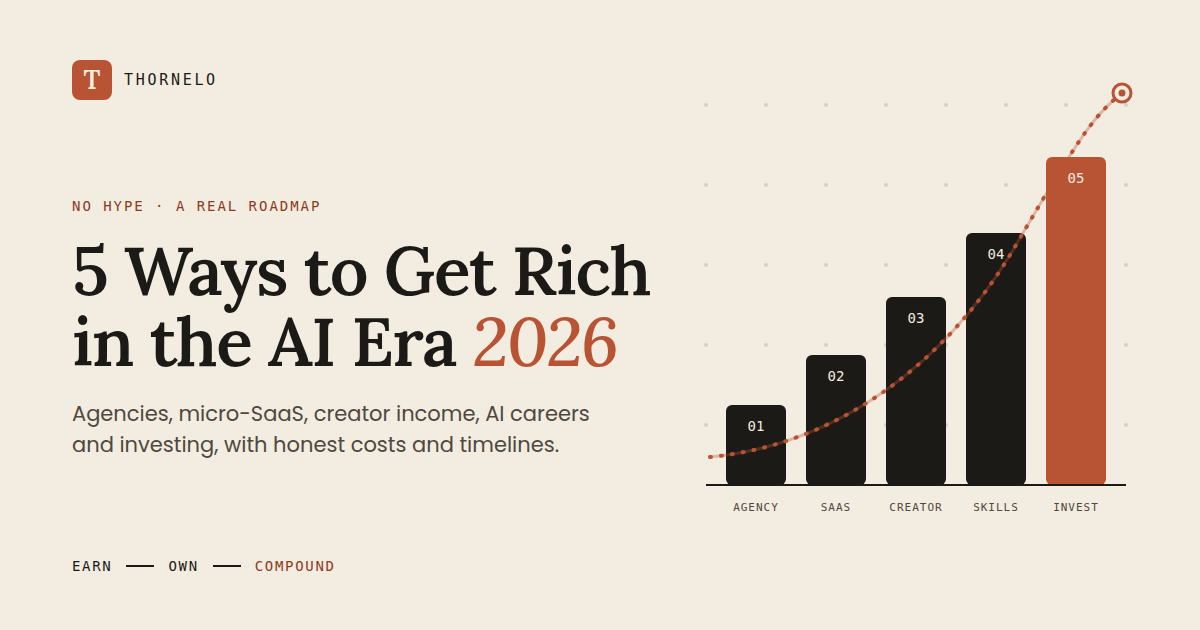
This guide covers the 5 ways to get rich in the AI era 2026 that still hold up once you do the math. For each one you get a roadmap, the tools, honest earning ranges, and the red flags that course sellers leave out. Nobody becomes a millionaire overnight here. The plan is skills, leverage, and ownership, stacked over time.
One definition first: in this guide, “rich” means building assets that pay you whether or not you’re online. One lucky viral month doesn’t count.
⚡ Key Takeaways
- AI automation agency: the fastest route from AI skills to cash. Costs little, and small businesses really need it.
- AI micro-SaaS: the highest ceiling because you own recurring revenue. Most products fail, though.
- AI-powered creator business: AI speeds up the content. Your expertise and digital products make the money.
- High-paying AI skills: the most reliable path. Companies pay a premium for people who make AI work in practice.
- Investing in the AI economy: where income becomes wealth. Slow, boring, powerful.
- Best way for most people to get rich in the AI era: earn with path 1, 3, or 4, own with path 2, and compound with path 5.
Can You Really Get Rich With AI in 2026?
Yes, you can get rich in the AI era, but “using AI” alone won’t do it. Everyone has ChatGPT, Claude, and Gemini now, so access by itself is worth nothing. The money goes to people who combine AI with a skill, a specific customer, and something they own.
Think of it as three levers:
- Skills get you paid (AI freelancing, careers).
- Leverage multiplies your output (AI agents, automation, content).
- Ownership builds wealth (products, SaaS, equity, investments).
Every path below pulls at least one lever, and the best ones pull two. 🔥
Way #1: Start an AI Automation Agency 🤖
What it is: An AI automation agency builds and maintains AI-powered workflows for businesses. Typical projects are lead follow-up bots, AI voice agents that answer calls, inbox triage, WhatsApp support assistants, and CRM automations. The usual pricing is a one-time setup fee plus a monthly retainer, and it’s the fastest path from AI skills to revenue in 2026.
Best for: Beginner-to-intermediate problem solvers with little capital. You don’t need to code, but you do need to understand one business process from start to finish.
Roadmap:
- Week 1: Pick ONE niche, such as dental clinics, real estate brokers, coaching institutes, or D2C brands. Pick ONE painful workflow in that niche, like missed leads. Learn the basics of n8n or Make.
- Month 1: Build two demo automations and record Loom walkthroughs of each. Offer a discounted pilot to one or two businesses in exchange for a testimonial.
- Month 3: Turn the work into a fixed-price, productized service, for example “missed-call-to-WhatsApp follow-up, live in 7 days.” Aim for 3–5 paying clients.
- Month 6+: Write down your processes, bring in a junior builder, and go deeper into your niche rather than adding new ones.
Tools for 2026: n8n, Make, Zapier, the Claude and OpenAI APIs, Vapi or Retell AI (voice agents), Voiceflow (chatbots), WhatsApp Business API, Airtable, HubSpot, Loom.
Earning potential: Pricing varies a lot by market, so run the numbers for yours. As an illustration, 5 Indian SMB clients paying a $300/month retainer adds up to $1,500/month. International clients often pay for the same work in dollars. If you’re doing outreach every week, first income usually arrives in 1–3 months.
Startup cost & time: Roughly $0–60/month for tools and API usage, plus 15–25 hours a week.
Mistakes & red flags:
- Selling “AI” instead of an outcome. Clients pay for “no more missed leads,” not for “GPT integration.”
- Chasing ten niches at once. It’s giving scattered. 😬
- Skipping a maintenance plan. Models and APIs change constantly, and agents nobody looks after break without anyone noticing.
- Being careless with customer data. Get consent and set up proper access controls.
Pro tip competitors skip: Deliver every agent with a test sheet of 20–30 real scenarios marked pass or fail. Business owners don’t trust “AI magic,” but they do trust proof. The sheet also justifies your retainer, because you re-run it every time the underlying model updates.
Way #2: Build an AI Micro-SaaS (Ownership Mode Unlocked) 💻
What it is: An AI micro-SaaS is a small software product that solves one narrow problem for a specific audience and charges a subscription. In 2026, AI coding tools let solo founders ship a working MVP in weeks rather than months. Owning the recurring revenue is what makes this an asset, and assets are how you get rich in the AI era.
Best for: Builders, semi-technical founders, and anyone with a few months of savings to live on. It’s also a natural next step after an agency, since your clients show you which problems keep coming up.
Roadmap:
- Week 1: Find a problem people already pay to solve. Talk to at least 10 potential users before you write any code.
- Month 1: Build the MVP with vibe coding tools, set up payments, and launch a landing page with a waitlist.
- Month 3: Get your first 10 paying users and talk to every one of them. Fix whatever makes them leave.
- Month 6+: Put your effort into distribution, meaning SEO, integrations, partnerships, and a free tool that brings in signups.
Tools for 2026: Cursor, Claude Code, Lovable, Bolt, Replit, v0, Supabase, Vercel, Stripe, Razorpay (for Indian customers), PostHog.
Earning potential: Brutal honesty: most micro-SaaS products earn little or nothing, but the winners compound. For example, 200 customers paying $20/month is $4,000 in monthly recurring revenue (MRR). A profitable SaaS can also be sold, and that sale is often where the real wealth comes from. First income usually takes 3–9 months.
Startup cost & time: About $25–175/month for tools, hosting, and API costs, plus 10–30 hours a week.
Mistakes & red flags:
- Building a thin “ChatGPT wrapper” that the next model update makes pointless.
- Ignoring unit economics. If each user costs you more in API calls than they pay, every new signup loses you money.
- Building before anyone has said they’d pay. Main character energy, zero customers.
Pro tip competitors skip: Ask yourself whether customers would still pay you if OpenAI, Anthropic, or Google shipped your product as a free feature tomorrow. If the answer is yes because you own a workflow, an integration, niche data, or the customer relationships, build it. If it’s no, pivot now.
Way #3: Run an AI-Powered Creator Business That Sells Digital Products 🎥
What it is: An AI-powered creator business uses AI for the production work: research, scripting, editing, repurposing, and thumbnails. You supply the expertise, personality, and opinions. Most of the money comes from selling your own digital products (templates, workflows, courses, cohorts) rather than from ads or brand deals alone.
Best for: People who enjoy teaching, explaining, or sharing what they learn. You need almost no money, but you do need patience.
Roadmap:
- Week 1: Pick a niche where your skill meets AI, such as “AI for CA students” or “AI for Shopify sellers.” Choose one main platform and start a newsletter.
- Month 1: Post 3–5 times a week, share what you’re learning as you go, and start collecting email addresses right away.
- Month 3: Launch a low-priced product (6–24), such as a Notion system, a prompt library, or an automation template.
- Month 6+: Add a higher-priced cohort, community, or consulting offer, and start pitching sponsors once your engagement is steady.
Tools for 2026: Claude or ChatGPT (scripting and research), CapCut, Descript, Opus Clip, Canva, ElevenLabs, Beehiiv or Substack, and Gumroad, Topmate, or Stan for selling.
Earning potential: Results are extremely uneven. Many creators earn little in their first six months, and a few break out. As a rough example, if 2% of 1,000 subscribers buy a $12 product, that’s about $240 per launch, and the number grows with your list. Digital products are the closest thing to passive income with AI, but they still need marketing and regular updates.
Startup cost & time: $0–35/month, plus 10–20 hours a week.
Mistakes & red flags:
- Mass-producing faceless AI slop. Platforms like YouTube have tightened monetization rules for repetitive, mass-produced content. Low effort = L.
- Building only on rented land. One algorithm change can wipe out your reach, but nobody can take your email list away.
- Selling “make money online” courses without having made any money yourself. People can tell, fr.
Pro tip competitors skip: Sell the workflow file, not the advice. An n8n template, a Claude Project setup, or a Notion system someone can duplicate is useful within five minutes of buying it. That beats a 40-video course most buyers never finish.
Way #4: Build High-Paying AI Skills and Careers 🧠
What it is: The most reliable way to get rich in the AI era is to become the person who makes AI work inside a company. AI engineers, AI product managers, and AI-native people in marketing, sales, finance, and ops earn a premium because companies need people who deliver results, not just demos.
Best for: Students, working professionals, and career switchers who want stable income that grows over time.
Roadmap:
- Week 1: Choose a lane. Builders learn Python, LLM APIs, RAG, agents, and evals. Operators apply AI workflows to the job they already do.
- Month 1: Build one public project that solves a real problem at work, and post it on GitHub or LinkedIn.
- Month 3: Aim for three portfolio projects with measurable results, and volunteer for AI projects at work.
- Month 6+: Use that proof to negotiate a raise, change roles, or land remote work with global companies that pay in dollars.
Skills and tools for 2026: Python, SQL, the Claude, OpenAI, and Gemini APIs, LangChain or LlamaIndex, pgvector or Pinecone, Model Context Protocol (MCP), evaluation frameworks, Claude Code, Cursor, n8n. Operators should get good with Claude, ChatGPT, Gemini, Perplexity, Microsoft Copilot, and advanced Excel.
Earning potential: In the US, AI engineering roles commonly pay well into six figures. In India, companies building AI products pay noticeably more for builders who can show proven work. A raise or role switch typically takes 3–12 months of consistent effort.
Startup cost & time: $0–120, since most good learning resources are free, plus 8–15 hours a week.
Mistakes & red flags:
- Collecting certificates instead of shipping projects.
- Treating “prompt engineer” as a career. In 2026, prompt engineering is a baseline skill everyone is expected to have, not a job title by itself.
- Ignoring domain knowledge. AI plus finance or AI plus healthcare beats generic AI every time.
Pro tip competitors skip: Put numbers on everything. “Built an AI support agent” is mid. “Built an AI support agent that cut first-response time from 4 hours to 10 minutes” gets you hired. Start tracking hours saved and money earned from day one.
Way #5: Invest in the AI Economy for the Long Term 📈
What it is: Investing in the AI economy means putting the income from Ways 1–4 into long-term, diversified assets that benefit from AI’s growth. For most people, that means broad index funds, with an optional, capped slice in AI infrastructure and software companies. It’s the slowest way to get rich in the AI era, and it’s the one that turns earned income into lasting wealth.
This section is general education, not financial advice. Consult a SEBI-registered adviser (India) or a licensed professional in your country before investing.
Best for: Anyone with a steady income, even a small one.
Roadmap:
- Week 1: Build an emergency fund and pay off high-interest debt, starting with credit cards.
- Month 1: Set up automatic monthly investing into diversified index funds. In India that’s a SIP.
- Month 3: Learn the AI value chain: chips, data centers, cloud, models, and apps. Decide whether you want any thematic exposure at all, and if you do, cap it.
- Month 6+: Rebalance once a year, and keep investing through both hype cycles and crashes.
Tools: Zerodha, Groww, or INDmoney in India, and Vanguard, Fidelity, or Schwab in the US. Perplexity or Claude can summarize annual reports, but check the summaries against the source.
Earning potential: Nobody honest can promise you returns, and markets sometimes fall hard. The payoff comes from compounding over years, not months.
Mistakes & red flags:
- Buying crypto tokens just because “AI” is in the name.
- Putting everything into one hyped stock.
- Paying for “AI trading bots” that guarantee daily returns. Scam, no cap.
Pro tip competitors skip: Check what you already own before buying anything “thematic.” Many broad global and US index funds already hold large AI-linked companies, so you may have more AI exposure than you think.
The 5 Ways to Get Rich in the AI Era 2026, Compared
Agencies and careers pay fastest. SaaS and investing have the highest long-term ceiling. The creator path sits in between, with the widest spread of outcomes.
| Path | Startup Cost | Difficulty | Time to First Income | Earning Ceiling | Risk |
| AI Automation Agency | Low | Medium | 1–3 months | High | Low–Medium |
| AI Micro-SaaS | Low–Medium | High | 3–9 months | Very high | High |
| Creator + Digital Products | Very low | Medium | 3–6 months | High (uneven) | Medium |
| AI Skills & Careers | Low | Medium–High | 3–12 months | High, stable | Low |
| Investing in AI Economy | Needs capital | Low to start | Years to be meaningful | Grows with capital | Market risk |
Which Path Should YOU Pick? 🤔
The best way to get rich in the AI era depends on what you have right now, not on what went viral this week.
- Skills but no money: start an AI automation agency or do AI freelancing.
- You can build, or want to learn: launch a micro-SaaS for a problem you’ve seen at least three times.
- You love talking and teaching: a creator business with digital products.
- You want stability: build AI skills in your current career.
- Everyone: invest a fixed slice of every income stream from month one.
The strongest move is to stack paths. Agency clients reveal SaaS ideas, your builds become content, your content brings in clients, and the profits get invested. That flywheel is the whole game. 🔁
Reality Check: AI Get-Rich-Quick Scams to Avoid 🚩
If an AI money scheme promises you’ll get rich in the AI era effortlessly, it’s almost always selling you a dream instead of a result. Watch for these red flags:
- Guaranteed daily or monthly income, especially with “no skills needed.”
- Dashboard screenshots as the only proof.
- “Fully automated faceless channels” or “set-and-forget” stores.
- Telegram or WhatsApp “task jobs” that ask you to deposit money first.
- AI trading bots or signal groups promising fixed returns.
- $1 courses that upsell a $600 “inner circle.”
- Anyone asking for passwords, OTPs, or bank details to “activate” your earnings.
The real way to get rich in the AI era looks boring up close: outreach, building, testing, fixing, and doing it again. That’s lowkey good news, because most people won’t bother.
FAQ
Can you really get rich with AI in 2026?
Yes, you can get rich in the AI era, but access to AI isn’t enough because everyone has it. Wealth comes from combining AI with a valuable skill, a specific customer, and something you own, like a product, a business, or an investment portfolio. Expect results to build over years, not overnight.
What is the best AI side hustle for beginners?
For most beginners, AI automation services or AI-assisted freelancing are the best place to start. They need little money, small businesses genuinely want them, and they teach you which problems people will pay to solve. Start with one niche and one workflow.
How much can you earn with AI in 2026?
There’s no standard figure. It depends on your skill, niche, pricing, and effort. A small agency with a few retainer clients can replace a salary over time, while SaaS and creator income vary widely. Be suspicious of anyone quoting guaranteed numbers.
Do I need coding skills to make money with AI?
No. No-code AI tools like n8n, Make, and Zapier, along with AI app builders like Lovable and Bolt, cover a lot of ground. Coding does raise your ceiling for SaaS and AI engineering roles, and AI coding assistants make it much faster to learn.
Is an AI automation agency still worth starting in 2026?
Yes, if you pick a niche. Agencies offering “AI for everyone” struggle. Specialists who solve one expensive problem for one industry and maintain it every month stay in demand, because most small businesses don’t have time to build and run automations themselves.
Is AI-generated content allowed on YouTube and Instagram?
Generally yes. Platforms expect you to disclose realistic AI-generated or altered media, and they restrict monetization of mass-produced, repetitive content. Use AI to speed up production while adding your own expertise, voice, and originality.
How much money do I need to start?
Most paths here can start with $0–60 a month in tools. Micro-SaaS may need more for hosting and API costs. Investing can start with a small monthly SIP. Your time is the real investment.
Is investing in AI stocks a good idea?
AI stocks can be part of a diversified portfolio, but concentrating your money in hyped AI stocks or tokens is risky. Many broad index funds already include major AI-linked companies. This is general information, not financial advice, so consult a licensed adviser.
Conclusion
None of the 5 ways to get rich in the AI era 2026 are secrets. Each is a choice: earn with skills, multiply with automation, own through products, and compound through investing.
To get rich in the AI era, your move is to pick ONE path, commit to a 30-day sprint, and ship something real, whether that’s a demo, a post, a project, or your first SIP. Momentum beats motivation every time, and W’s are built, not found. 💸
Leave a comment